By Keith Addison, NewsPeak
May 4, 2012 – Protesters are waging a campaign against London's 2012 Olympics chief, former athlete Sebastian Coe, now Baron Coe, KBE. Demonstrators have burned effigies of him in the streets. It's sure to get noisier.
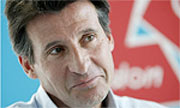 To help sponsor "the greenest Games ever", Conservative politician Lord Coe has chosen three of the world's top 10 criminal corporations as Olympics "Sustainability Partners": BP, most recently of Deepwater Horizon fame (for less recent abysmal behaviour see HERE), Dow Chemical, which bears responsibility for the corporate crime of the century, the mass gassing at Bhopal in India in 1984, which killed thousands and is still unresolved, and Rio Tinto, which faces charges of environmental harm and human-rights abuses from Indonesia and Papua New Guinea to Mongolia and Utah.
All three are embroiled in lawsuits over charges of large-scale environmental and other harm.
Three watchdog groups, London Mining Network, Bhopal Medical Appeal and UK Tar Sands Network, are offering a faux-Olympics Greenwash Gold 2012 award, where protesters can vote for BP, Dow or Rio Tinto as "the company covering up the most environmental destruction and devastating the most communities while pretending to be a good corporate citizen by sponsoring the Olympic Games".
Indian groups are outraged that Dow Chemical should be associated with the Olympics in any way and are demanding that the Olympic organisers drop Dow. The Olympic Association of India and many others are calling for India to boycott the Games if Dow is not dropped.
But Coe refuses to expel Dow. Referring to the Bhopal tragedy, he said: "I feel comfortable after analysing the history of this case."
That's nice for him, that he feels comfortable, but his clueless choice of terms brought him a storm of scorn and derision, and more demos, and now he's back-tracking: "Of course I will meet the protesters."
It's beyond me how anyone could feel comfortable with any aspect of the Bhopal disaster. It's not just ancient news, it's still happening today. The mass poisoning at Bhopal in India 27 years ago killed thousands of people outright and thousands more have died since, while 120,000 survivors still struggle to live with severe health problems. People poisoned then are still dying now as a result of their injuries. Long after the explosion, children were being born with crippling health damage and disabilities, facing a lifetime of suffering. Water in the local wells is still poisoned. In 2002, lead, mercury and organochlorines were found in the breast-milk of local women, and therefore in their children. There is no escape.
The disaster happened when an explosion at a pesticides factory caused a massive leak of poison gases, which blanketed a large part of the city. The factory was owned and operated by Union Carbide Corporation, a US-based company that owned 700 chemicals factories around the world and left a long trail of pollution scandals in its wake, and is now owned by Dow Chemical.
By legal sleight-of-hand corporations have gained "personhood", and probably have more human rights than you do. But the Bhopal disaster provides a vivid picture of just how "human" corporations really are.
In 2001, Union Carbide morphed into Dow Chemical, which, whatever Dow Chemical might like to say about it, thus acquired responsibility and liability for the Bhopal disaster.
Environmental and human rights groups have kept up a relentless pressure on Union Carbide/Dow Chemical to bring justice to Bhopal. Dow says it was all settled long ago. Lord Coe agrees with Dow.
The facts of what happened that dreadful night are not controversial, nor even contested: all the many studies and reports by reputable, credible investigators concur on the details, including legal investigations.
Only Union Carbide/Dow Chemical disagrees – they say the factory was sabotaged.
Soon after the disaster Union Carbide claimed that a previously unknown gang of Sikh extremists called "Black June" had admitted sabotaging the plant. The claim was dismissed by the Indian government, the police, the news media, and a judge in the US case in New York.
So Union Carbide changed its story, blaming a "disgruntled employee" instead, though it has never been able to name him. To this day the company claims it is a victim of sabotage. (Nothing further has ever been heard of "Black June".)
In any case, according to the International Campaign for Justice in Bhopal, "Sabotage would be irrelevant to any legal determination of liability. Even if sabotage were established, Carbide would be liable for allowing it to happen: an act by an employee is not an 'act by a stranger', which is the only legal distinction that could let it off the hook... The Bhopal plant was sabotaged – by the negligence and cost-cutting of Union Carbide." (See bhopal.net http://bhopal.net/the-sabotage-theory/)
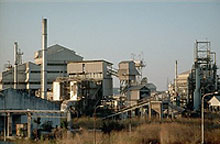 This is what happened – judge for yourself:
On the night of December 2, 1984, an explosion at Union Carbide's pesticide factory in the city of Bhopal released a cloud of poison gas which killed at least 8,000 people, injuring another half-million. A further 12,000 victims have died since then.
The disaster was and still is today an appalling atrocity, still ongoing after 27 years, a major crime against humanity and something we all should know about. And be outraged about. The bald, bare facts are bad enough, but the full picture in all its sickening detail is far worse, and it's important to get the full picture.
The unit that exploded at the Bhopal plant produced methyl isocyanate (MIC), an extremely dangerous chemical used in the production of Sevin insecticide (carbaryl). Though the design of the unit was based on another Union Carbide plant in West Virginia, grossly lower standards were employed at Bhopal in the selection of construction material, monitoring devices and safety systems.
The Bhopal factory was running at a loss, and Union Carbide was out to save money at all costs. Accidental leaks from all the Bhopal units were frequent, and operators and workers were regularly exposed to a variety of toxic chemicals. On the night of the explosion, the most important safety systems had either been shut down or were under repair and not functioning.
Between 1980 and 1984 the work crew of the MIC unit was halved from 12 to six workers, and the maintenance crew was cut from six to two workers. Training was cut from six months to two weeks. Workers who spoke only Hindi were given English safety manuals.
In December 1981 a plant operator was killed by a phosgene gas leak. (Phosgene was used as poison gas during World War 1.) Another phosgene leak in January 1982 severely injured 28 workers and in October the same year MIC escaped from a broken valve and four workers were exposed.
Before the disaster in 1984, the company responded to environmental safety concerns by private citizens with legal threats, and punished workers who raised occupational health concerns.
Senior Union Carbide officials were privy to a "business confidential" safety audit undertaken in May 1982 and knew about 61 hazards at the plant, 30 of them major, with 11 hazards in the dangerous phosgene and MIC units. Among other things, the audit found failing valves, corroded pipes, untrained staff and a severely inadequate water spray, and warned of the danger of a "major toxic release".
The company took remedial measures at its MIC plant in West Virginia, but not in Bhopal.
Secret Union Carbide documents obtained by "discovery" during the class action suit brought by survivors against the company in New York revealed that the technology used at the Bhopal factory – including the crucial units manufacturing carbon monoxide and methyl isocyanate – was unproven, and that the company knew it posed unknown risks. Union Carbide knew the danger, but saw it as an acceptable "business risk".
Senior Union Carbide officials, including CEO Warren Anderson, not only knew about design defects and potential safety problems at the Bhopal factory, they authorised them.
On the night of the disaster, almost a ton of water that was being used to clean pipes washed into MIC tank E610 through faulty valves. The refrigeration unit, which should have kept the MIC below 5 degrees centigrade, had been shut off by company officials to save on electricity bills. The water gushed into the tank, filled with MIC at ambient temperature, and sparked a runaway exothermic reaction, triggering the explosion. A mass of chemicals boiled out of the MIC tank, releasing 40 tons of lethal gases into the atmosphere.
The safety systems were either under repair or not functioning, and in any case were not designed for such a runaway situation.
Nobody outside the factory was warned because the safety siren was turned off.
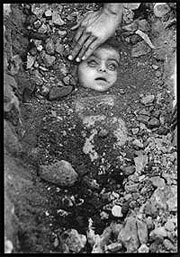 The dead were hastily buried in three tiers because there were so many of them.
|
The huge cloud of deadly gas quickly spread out from the factory and enveloped an area of over 20 square kilometers (nearly 8 square miles).
People woke up coughing, gasping for breath, their eyes burning. Many died outright, or fell dead as they tried to run away. Others died at the hospitals, where doctors were overwhelmed by the sheer numbers of victims, and lacked information on the nature of the poison. Dawn broke over streets littered with corpses.
By the third day of the disaster, an estimated 8,000 people had died from direct exposure to the gas, and a further 500,000 were injured.
Poisons from the gases, including hydrogen cyanide, circulated through the bloodstreams of victims, damaging eyes, lungs, kidneys, liver, intestines, muscles, brain and reproductive and immune systems.
Some 40% of women who were pregnant at the time of the disaster aborted; most of the children who were born had severe health problems, with gross motor and language development defects and chromosomal damage.
Studies by the Indian Council of Medical Research found that the number of people with exposure-related symptoms, especially lung injuries, actually increased between 1987 and 1991, with three times more people with respiratory symptoms in 1991 than in 1987.
Today, the total number of deaths stands at 22,917. Of the 542,213 people injured, more than 120,000 are still chronically ill.
You'd think that by now the survivors would have received proper medical care, that they'd have been compensated for their loss and their suffering, that somebody would have had to answer in court for what was done to them. On all counts, you'd be wrong.
Union Carbide/Dow did indeed pay compensation – 7 cents a day, for 27 years of suffering. On 7 cents a day the survivors have had to struggle against pain, breathlessness, giddiness, numb limbs, aching bodies, fevers, nausea, brain damage, cancers, anxiety attacks, menstrual chaos, depression and mental illness. Thirty people still die every month from the effects of the gas.
Union Carbide/Dow paid compensation of $10,000,000 for an American child brain-damaged by one of their pesticides (Dursban), and $500 for an Indian child brain-damaged by its Bhopal pesticide factory.
When asked if this was not a blatant example of double standards, Dow Public Affairs Leader Kathy Hunt said: "$500 is plenty good for an Indian."
(Dursban was withdrawn from household use in the US, but Dow still markets it as "safe" in India.)
Meanwhile the drinking water of the same communities that were hit in 1984 is being poisoned by cancer- and birth-defect causing chemicals that lie in the open in the derelict factory, or were dumped on waste ground by the company for up to 10 years after the disaster. Greenpeace found mercury pollution at the site at levels up to 6 million times higher than normal levels.
"As early as 1972, Carbide's American managers talked about the danger of ground-water pollution from that terrible factory," said Rashida Bi, leader of a Bhopal survivors organisation which is a plaintiff in the case against Dow. "They made their own proposals to stop it happening – and then ignored them. Instead, knowing the dangers, they set about dumping thousands of tonnes of solid and liquid chemical wastes in and outside the factory. They knew it would poison our water and our daily lives and they did it anyway." More than 20,000 people live close to the factory site.
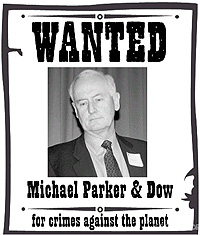 In May 2002, faced with a demand by a delegation of Bhopal activists that Dow assume responsibility for cleaning up Carbide's deadly mess in Bhopal, Dow CEO Michael Parker suggested that a portion of the pitiful compensation Carbide had paid to the Bhopal victims should be used to clean up the factory contamination. Dow-Carbide wants its victims to pay for cleaning up the mess it made.
The Journal of the American Medical Association published a ground-breaking study carried out by the Sambhavna Trust Clinic in Bhopal, proving that the poison gases released by Union Carbide in the 1984 disaster have had a severe medical impact on a generation as yet unborn at the time, with physical abnormalities of children born to women who breathed Carbide's gases.
Unbelievably, the Indian taxpayer has been left to pick up the costs of health care, economic support and social rehabilitation schemes.
The Bhopal factory is still a time-bomb, with tons of highly toxic chemicals and wastes simply dumped there without any precaution or maintenance. Union Carbide/Dow refuse to acknowledge this, saying it is India's responsibility.
For what sum of money did Carbide find it worth risking a whole Indian city?
"Union Carbide stored liquid MIC in Bhopal in huge tanks, far in excess of what would have been permitted in the US. MIC is a dangerously volatile chemical and these tanks were supposed to be kept cooled to 0 deg C. It is known that for some months prior to the huge and fatal gas leak of December 1984, the refrigeration system had been switched off to save the cost of freon gas. For the last 18 years, survivors have wondered just how much the company must have been saving, to make it worth risking the lives of an entire Indian city. Now we know. The figure was $37.68 per day." (bhopal.net)
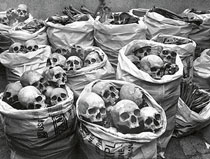 The details of environmental pollution at the Carbide Bhopal plant are appalling – reading the 5,000-word report is chilling. It's impossible to imagine how any human could behave this way: the charges of "carelessness", "ruthless disregard of safety", "criminal neglect", "environmental vandalism" are far too mild. Chernobyl and Fukushima might arguably be in worse shape, but Chernobyl and Fukushima were accidents. The atrocious mess at Bhopal was no ordinary accident.
From the opening of the factory in 1969, toxic wastes were routinely dumped inside the site, both above and below ground. Huge amounts of waste were simply buried; hundreds of tonnes were not even buried. Much is "stored" in unidentified sacks. Storage tanks have burst, spilling tons of lethal chemicals. Random sacks of waste, waste drums, chemical bottles and other hazardous items lie strewn in the open air around the surface of the three chief site disposal areas, where chemicals were routinely dumped into pits.
According to former workers at the factory, from December 1969 to December 1984 massive amounts of solid and liquid chemicals formulated in the factory – pesticides, as well as solvents, catalysts and other substances used in production, along with their by-products – were routinely dumped in and around the factory grounds, polluting the soil, water and air.
Dumping of toxic materials continued even after the disaster in 1984. In 1995 the company poured ortho-dichlorobenzenes directly onto the ground at the north perimeter wall. Nearby residents attested that within weeks drinking water from the local community tubewells became yellow and foul tasting. (Ortho-dichlorobenzenes can cause liver damage, kidney damage and leukemia.)
In 1977, Union Carbide built 14 hectares of solar evaporation ponds 400 metres north of the factory and dumped toxic chemical wastes and by-products at these sites. Every year during the rainy season the ponds overflowed and contaminated large areas of farmland. Two nearby tubewells had to be abandoned because of the foul smell and taste of the water.
Toxic effluents were also routinely discharged into an open sewage drain flowing past Jai Prakash Nagar, a community on the south side of the factory that was badly affected by the 1984 tragedy.
In 1995 fountains of polluted wastewater were being pumped into the ponds. In 1996 management tried to cover up the environmental damage caused by the ponds: the toxic sludge was all dumped into one pond and covered over with farm soil, layers of polythene, and finally a concrete cover. The two other ponds were levelled (during which their black polythene liners were ruptured). Soil has since eroded around the concrete covers, contaminating the surrounding water.
Following a 1996 study, the Bhopal Municipal Corporation declared more than 100 wells in the vicinity of the plant unfit for drinking. No alternative provision was made.
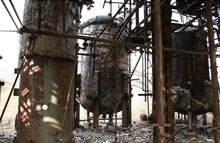 In 1999 Greenpeace International collected 33 samples of soil and 22 samples of groundwater in and around the factory site. After analysis of the samples, Greenpeace declared the site a "global toxic hotspot" (The Bhopal Legacy, Greenpeace Research Laboratories, University of Exeter, Nov. 1999, download HERE – 737 kb PDF).
They found heavy concentrations of cancer-causing chemicals and heavy metals such as mercury. Mercury was found at between 20,000 to 6 million times the expected levels. Elemental mercury was widely distributed across the plant premises. Twelve volatile organic compounds, most of them greatly exceeding US Environmental Protection Agency limits, were seeping into the water supplies of an estimated 20,000 people in the area.
A government report in 1996 said: "Water from tubewells in other parts of Bhopal were examined at this laboratory. However, chemical contamination was found only in these areas. The tubewells in these areas were tested five years back and at that time too the results showed chemical contamination. Hence, it is established that this pollution is due to chemicals used in the Union Carbide factory that have proven to be extremely harmful for health. Therefore the use of this water for drinking must be stopped immediately."
Independent analysis in Boston and other studies concur, painting a nightmarish picture of large amounts of lethal pollutants out of control in the local environment and in the local communities.
Greenpeace concluded: "As a result of the ubiquitous presence of contaminants, the exposure of the communities surrounding the plants to complex mixtures of hazardous chemicals continues on a daily basis... long-term chronic exposure to mixtures of toxic synthetic chemicals and heavy metals is also likely to have serious consequences for the health and survival of the local population."
Union Carbide/Dow has ever since refused to provide detailed medical information on the leaked gases, claiming it is a "trade secret".
Many of the chemicals involved cause cancer and have a bio-accumulative effect (they build up in the body). For the local communities, poisoning is almost routine. Local people suffer abdominal pain, skin lesions, dizziness, vomiting, constipation, indigestion, and burning sensations in the chest and stomach. Children are born seriously underweight, weak, with discolored skin, suffering from multi-systemic health problems. Women complain of suppression of lactation and some stop lactating within a month of giving birth.
Union Carbide and Dow simply deny it all. Replying to Greenpeace's allegations in 1999, Union Carbide said it had had no information regarding the Bhopal plant site since it sold its stock in Union Carbide India Limited (UCIL) more than five years earlier – ignoring the fact that it had had plenty of information up until 1994.
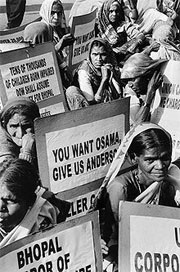 At the time of the disaster, Union Carbide quickly demonstrated where its true priorities lay. The corporation's legal damage-control team arrived in Bhopal days before their medical team showed up. The medical team claimed that the leaked gases would not have any long-term health effects. They said the leaked chemicals were "nothing more than a potent tear gas", that the reports of deaths were greatly exaggerated, and that the leak had only killed 1,408 people, while "40 persons were with permanent total disability and 2,680 persons were with permanent partial disability" from gas exposure, and that "massive, one-time exposure to MIC has not caused cancer, birth defects, or other delayed manifestations of medical effects".
After taking over Union Carbide, Dow accepted Carbide's asbestos-related liabilities in the US, paying multi-million dollar damages. But it refuses to accept Carbide's Indian responsibilities.
Carbide paid damages of $470 million in 1989, though the amount sought was $3.3 billion, and the company also paid $107 million towards various relief efforts. The Indian government is seeking $1.7 billion more for problems still being encountered after the disaster.
The world's biggest industrial accident had cost Union Carbide just 48 cents a share. If the accident had happened in the US, the company would have been bankrupted overnight.
The Bhopal disaster was sheer corporate terrorism, complete with Weapons of Mass Destruction.
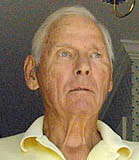 Ex-Union Carbide CEO Warren Anderson is the world's No. 1 corporate criminal, an international fugitive from charges of multiple culpable homicide, with an extradition order from the government of India pending against him for the past 27 years after he jumped bail there and fled to the US. If he were extradited to India he'd face a sentence of 10 to 20 years in an Indian prison. So far, all it's cost him is the $2,000 bail money.
The US authorities had always insisted they did not know his whereabouts, but in 2002 he was unearthed by a UK newspaper and Greenpeace, living a comfortable life in retirement in the exclusive Hamptons in Long Island, New York. Greenpeace videotaped Anderson and handed him a warrant for his arrest. He denied who he was and fled inside the house.
The journalists discovered that Anderson's subscription to his local golf club costs $2,700 a year, more than five times what Union Carbide's victims in Bhopal got for a lifetime of illness and suffering.
"If a team of journalists and Greenpeace managed to track down India's most wanted man in a matter of days, how seriously have the US authorities tried to find him all these years?" asked Greenpeace campaigner Casey Harrell in the US.
Maybe it would help if the FBI posted a $25 million reward for him, as they did for that other terrorist of the century, Osama bin Laden.
Sebastian Coe is in danger of turning "the greenest Olympics ever" into a travesty. If he doesn't agree to find more suitable sponsors he should be replaced by someone who will.
Resources
Worldwide, an estimated 355,000 people die from pesticide exposure every year. This means that nearly 1,000 men, women, and children die on an average day. – Source: World Bank
The International Campaign for Justice in Bhopal
http://www.bhopal.net/index.php
Quick fact tour
The disaster
How could it happen?
Medical consequences
Today in Bhopal
Union Carbide's response
Union Carbide's toxic legacy
Long-term issues
http://www.bhopal.net/oldsite/intro2.html
Carbide's Poison Papers
Internal documents Union Carbide was forced to disclose during the ongoing Class action filed by Bhopal survivors in the Federal Southern District court of New York, which alleges that the company demonstrated reckless and depraved indifference to human life through its Bhopal operations.
http://www.bhopal.net/oldsite/poisonpapers.html
Bhopal.Org hosts the Bhopal Medical Appeal funding free clinics for Bhopal survivors.
http://www.bhopal.org/
The Bhopal Legacy, Greenpeace Research Laboratories, University of Exeter, Nov. 1999, download HERE – 737 kb PDF
Greenwash Gold 2012
http://www.greenwashgold.org/

Community development | Rural development
City farms | Organic gardening | Composting | Small farms | Biofuel | Solar box cookers
Trees, soil and water | Seeds of the world | Appropriate technology | Project vehicles
Home | What people are saying about us | About Handmade Projects
Projects | Internet | Schools projects | Sitemap | Site Search | Donations | Contact us