

|
Journey to Forever: Make a donation |

En español
Biocombustibles, biodiesel
Navigation
Contact usTo Keith Addison Handmade Projects |
 New!
New!
The Biodiesel Bible
by Keith Addison, Journey to Forever
This is the only book that thoroughly covers the entire subject of making your own biodiesel – all the information at the Journey to Forever website and very much more.
Learn how to make top-quality biodiesel that will pass all the quality standards requirements every time.
We haven't had a failed batch for 11 years! (But if you do have a failed batch we tell you how to rescue it – and how to improve your processing so it won't happen again.)
Save money! Making your own biodiesel will save you thousands.
Click HERE
New! Build a 3-inch ethanol still – Click HERE
Biofuels
Spanish version -- Versión en español Spanish Spanish-language version HERE. We had three main aims in learning to make biofuels: Both biodiesel and ethanol are clean, grow-your-own fuels that can be made on-site in villages or local communities from renewable, locally available resources, for the most part using simple equipment that a local workshop can make and maintain. There's been a growing storm of protest against biofuels in the last few years, rising to a frenzy this year (2008) as the global food crisis hit home. Two very frequently asked questions. -- Composts: Closing the Loop, Foodshare Toronto "We did a study in India where we showed that it is possible to take care of energy needs completely by biomass and its various derivatives for a block of about 100 villages." -- Dr. Anil K. Rajvanshi, Director, Nimbkar Agricultural Research Institute (NARI) Here's Dr. Rajvanshi's study: Talukas can provide critical mass for India’s sustainable development, Anil K. Rajvanshi, Current Science, Vol. 82, No. 6, 25 March 2002 "More efficient use is already America's biggest energy source -- not oil, gas, coal, or nuclear power. By 2000, reduced 'energy intensity' (compared with 1975) was providing 40 percent of all U.S. energy services. It was 73 percent greater than U.S. oil consumption, five times domestic oil production, three times total oil imports, and 13 times Persian Gulf oil imports. The lower intensity was mostly achieved by more productive use of energy (such as better-insulated houses, better-designed lights and motors, and cars that were safer, cleaner, more powerful, and got more miles per gallon), partly by shifts in the economic mix, and only slightly by behavioral change. Since 1996, saved energy has been the nation's fastest-growing major 'source.'" -- Amory B. Lovins "Negawatts powerplant" energy efficiency programs can save large amounts of energy and large amounts of money. 2.1 jobs are created in energy efficiency/conservation in comparison to one new job for an equivalent amount of BTUs in new energy production. "I remember canvassing the Orlando, Florida area attempting to generate public support for a 'negawatts powerplant' rather than Orlando Utilities Commission expanding Curtis Stanton I into Curtis Stanton II (both coal fired). The most conservative calculations were that a modest to robust energy efficiency program could forestall the need for Stanton II for at minimum 10 years, in turn saving the public literally hundreds of millions of dollars. (Mind you this is a publicly owned utility, with the supposed obligation to serve the public interests.)..." The Negawatt Revolution, Amory B. Lovins, The Conference Board Magazine, Vol. XXVII No. 9, September 1990, 232kb PDF. "Marijuana is the top cash crop in 12 states and among the top three cash crops in 30, according to a new study. The study estimates that marijuana production, at a value of $35.8 billion, exceeds the combined value of corn ($23.3 billion) and wheat ($7.5 billion)." See "Marijuana Called Top U.S. Cash Crop", ABC News, February 14, 2007 We've been saying that for years. Now even the US military is saying similar things (see box, right). -- Kyoto, November 2005 Cutting fuel costs From Grist Magazine -- by Josh Sevin
SUV: 4,591 Source: US Bureau of Transportation Statistics Jet fuel: 3000+ ppm Sulfur The Biofuel mailing list online discussion group run by Journey to Forever has closed, as of March 2012. The list was at the forefront of small-scale biofuels development for 12 years. It was one of the first groups to use open-source information exchange to develop appropriate technology solutions rather than alternative software. It had a large and varied global membership and covered all aspects of biofuels – biodiesel, ethanol, other alternative fuels, related technologies and issues, energy issues, environment, ecology, sustainability, and more. A total of more than 77,000 messages were posted. All of them are permanently stored in a searchable archives on the Web where anyone can read them free of charge, and many do. The archives is here: Other messages in the thread are hot-linked at the end of each page, so you can "drill down" to find what you're after. Comments We're planning to start a new kind of online community, but it will take a little time. All previous Biofuel list members will be invited to join when it's ready. If you're interested, send us an email with the subject title Join new group, and we'll put you on the invitation list. NOTE: You don't need to join a list to learn how to make biodiesel. Start here: Where do I start? Follow the instructions, step by step. Forget everything else you've read. Study everything on that page and the next page and at the links in the text. It tells you everything you need to know. Biofuels
Why make biofuels?
Food vs fuel?
How much fuel can we grow? How much land will it take?
Cutting fuel costs
Food miles
Car facts and transportation
Biofuel mailing list
"How can you say you're environmentalists?" asked a local sceptic in Hong Kong. "Your Land Rovers aren't green at all -- one runs on leaded petrol and the other's a dirty diesel."
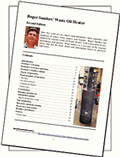 Free heating!
Roger Sanders has updated his popular improved version of the Mother Earth News waste oil heater with a great deal of new information and new options.
This waste oil heater solves all the problems that made the original MEN version difficult to use.
Roger's design is simple and reliable -- it's easy to build and easy to use, it's quiet, it uses no electricity, it's easy to light, easy to clean and easy to control, it has a wide heat range, and it runs on waste vegetable oil (WVO) just as well as on used engine oil. It can save you thousands of dollars in heating bills.
The Second Edition is available as a pdf e-book, price $22.50. Complete DIY instructions -- buy it HERE.
"Um," we said, thinking fast... "but if everyone had cars like ours, there'd be no need for roads."
In fact no car built today has such low manufacturing eco-costs as a Series Land Rover. And these old Land Rovers last and last: "My Land Rover is 41 years old and has prevented the need to build at least five replacements during that time." -- Series I owner, England, Land Rover Owners Internet mailing list, December 1999.
Land Rover stopped building the Series models in 1985. (See Project vehicles. See also The best car in the world.) The motor industry now produces 100,000 new vehicles a day worldwide. (See Car facts.)
But our critic had a point: the vehicles were green enough (even the blue one), but their fuel certainly wasn't. But we didn't plan to pollute the atmosphere with dirty fossil-fuel exhaust fumes all the way from Hong Kong to Cape Town. There are better, cleaner, fuels -- and you can make them yourself!
Why make biofuels?
These fuels are among a range of sustainable local energy options. Others are methane (biogas) digesters that turn livestock, crop and food wastes into cooking and heating gas, solar energy (see Solar box cookers), wood gas, charcoal and fuelwood (good fuels unless overharvesting destroys the trees themselves), wind power, water power.
Usually the "answer" is in a mix of technologies. Biofuels can be used to power small-scale farm and local workshop machinery and electricity generators as well as vehicles. Knowing how to make biofuels provides a useful set of ecological questions in investigating local energy options, questions that are worth asking even if the final answer is "No".
 The Emperor's New Hydrogen Economy, by Darryl McMahon, iUniverse, September, 2006, 322 pages, ISBN: 9780595392292 -- also available as an E-Book
In exposing the sheer stitchlessness of the scheme announced by President Bush in 2003 for America to "lead the world in developing clean, hydrogen-powered automobiles", Darryl McMahon has written one of the most useful energy books going.
As he says, "the hydrogen economy is a really, really bad idea", for a dismaying number of reasons both technical and practical.
In explaining just why it's such a bad idea, McMahon sheds much light, debunks the myths, and provides a thorough, clear, rational and well-informed overview of all the existing energy options, both sustainable and not.
The second half of the book is devoted to better ideas -- what you can do about it, focusing on real solutions that work now, along with a detailed, 4-chapter, 100-page Personal Energy Plan, also thorough, sensible and workable.
It's an easy read. McMahon has a sure touch, you know you're in good hands. He's been involved in energy and sustainability issues since the 1970s. Darryl lives in Ottawa and he prefers to take the bus, but he also has an electric car, an electric bicycle and a biodiesel truck, as well as an electric tractor he uses to raise organic vegetables.
Recommended -- see Econogics, Darryl's website.
For instance, should a crop such as peanuts be used to make fuel, or would the villagers be better off eating the peanuts? Or selling them? Should they press them to produce oil, for cooking or for selling or for fuel, and feed the high-protein seedcake residue to livestock, which in turn they can either eat or sell, while using the livestock wastes (and the crop wastes) to make compost to renew the soil, or to generate biogas for cooking and heating, or both? (The heat generated by the composting process can also be harnessed for heating.) Or should they grow a different crop altogether for its energy potential?
Should a grain crop be distilled to make ethanol fuel or should the villagers eat the grain? If they use the grain for livestock feed, it can be used for ethanol and still feed the livestock: the fermentation process to produce ethanol converts the carbohydrates in the grain while leaving the protein, with the addition of the high-protein yeast that does the fermenting. The residue is high-quality livestock feed, which can be supplemented by forage crops which humans can't eat. This could mean improved utilization of the available resources.
This is the sort of question we'll have to find answers for in our work in rural villages. As always, it will be for the villagers to decide.
Foundation for Alternative Energy, Slovakia -- a good summary of the various ways to derive useful energy from biomass (34,000-word article):
http://www.seps.sk/zp/fond/dieret/biomass.html
Food vs fuel?
The anti-biofuels controversy
It's been claimed that biofuels are "even worse than fossil fuel", that biofuel production is driving millions of poor people into starvation, that biofuels are a "crime against humanity" -- it's reported that tropical rainforests are being destroyed to make way for biofuels crop plantations, while good farmland is being used to raise biofuels crops instead of food, creating food shortages and driving up food prices, especially for the world's poor.
Dozens of countries have seen food riots as prices soared out of reach and angry people took to the streets.
Authorities estimate that the crisis has already driven at least 30 million more poor people to hunger, and warn that the numbers of the newly hungry could rise to as much as 290 million or even much higher. And they say much of the blame lies with biofuels production.
Are biofuels really to blame?
Yes, partly, but there's more to it than that -- it doesn't work quite that way, and neither does hunger.
First of all, not all biofuels are the same.
GRAIN, an international non-governmental organisation that promotes sustainable agriculture, defined what isn't biofuel in an excellent 60-page report in June 2007 on the damage the biofuels "craze" is causing:
"We believe that the prefix bio, which comes from the Greek word for 'life', is entirely inappropriate for such anti-life devastation.
"So, following the lead of non-governmental organisations and social movements in Latin America, we do not talk about biofuels and green energy.
"Agrofuels is a much better term, we believe, to express what is really happening: agribusiness producing fuel from plants as another commodity in a wasteful, destructive and unjust global economy."
http://www.grain.org/nfg/?id=502
Quite right.
But GRAIN didn't define what biofuel is, only what it isn't.
Real biofuel that causes no anti-life devastation is being produced worldwide by thousands upon thousands of small-scale projects focusing on local production for local use. They use renewable, locally available resources wherever possible, including wastes, and they fit in with the local community and the local environment.
Nobody knows quite how many of them there are or how much fuel they produce, but it totals many millions of gallons a year, going up fast, and that many millions of gallons a year of fossil fuels not used.
This is the Appropriate Technology approach founded in 1973 by the British economist Dr. E.F. Schumacher in his famous book Small is Beautiful -- Economics as if people mattered, which is still the foundation text on a sustainable future.
None of the arguments against agrofuels apply to this type of biofuels production, whether it's of biodiesel, ethanol, biogas or whatever.
Real biofuels are indeed clean, green, renewable and sustainable, and it's real biofuels that Journey to Forever promotes and has helped to develop.
"Small is beautifuel," commented Prof. Pagandai Pannirselvam of Brazil at the Biofuel email discussion group hosted by Journey to Forever.
And big is agrofuel, not beautifuel.
Like all agribusiness crops, agrofuels are industrialised monocrops that guzzle fossil-fuels, spew out greenhouse gases, wreck the environment and the soil, impoverish local people and are unsustainable in every way.
Objections to biofuels-as-agrofuels are really just objections to industrialised agriculture itself, along with "free trade" (free of regulations) and all the other trappings of the global food system that help to make it so destructive.
With the demand for agrofuels soaring in the rich countries, agribusiness palm-oil production in the tropical countries is indeed even more evil than it used to be, and it is causing rainforest destruction as the palm-oil plantations spread. But it's really just a difference in scale and degree, it's nothing new -- it was doing that anyway long before the demand for agrofuels arose.
It's the same with the other cases where agrofuels production is damaging the environment and ruining local people's livelihoods, it's just agribusiness-as-usual, only worse.
The hunger also isn't new. The number of hungry people has been fairly constant at about 850 million for at least 20 years. The current estimate is that 862 million people are starving and nearly 3 billion are undernourished -- nearly half of humanity.
A Worldwatch Institute report, "Biofuels for Transport", prepared for the German Federal Ministry of Food, Agriculture and Consumer Protection in 2007, calls for policies to promote small-scale, labour-intensive production of biofuels crops rather than "large plantations of monocultures controlled by wealthy producers, who could drive farmers from their land..." See "Biofuels for Transport: Global potential and implications for sustainable energy and agriculture in the 21st Century", Worldwatch Institute, Earthscan, 2007, 452pp.
http://www.earthscan.co.uk/?tabid=1161
Extended summary:
http://www.worldwatch.org/system/files/EBF038.pdf
More and more people are saying similar things, including some rather prominent ones.
Since January 2008, Professor Robert Watson, chief scientist at the UK's Department of Environment Food and Rural Affairs (DEFRA) and Director of the UN's ground-breaking IAASTD World Agriculture Report released in April, as well as the UK government chief scientific adviser Professor John Beddington, plus his predecessor Dr David King, along with a British Royal Society report of a 14-month study on biofuels, and the IAASTD World Agriculture Report itself, have all attacked biofuels production for causing rainforest destruction and displacing food crops and small farmers, and for causing more carbon emissions than they save.
But they all pointed out that not all biofuels are the same: there are "good" biofuels and "bad" biofuels.
The IAASTD World Agriculture Report, the work of more than 400 scientists over four years and the biggest study of its kind ever conducted, said: "Small-scale biofuels could offer livelihood opportunities, especially in remote regions and countries where high transport costs impede agricultural trade and energy imports."
The British Royal Society report said: "Each biofuel must be assessed on its own merits." See Sustainable biofuels: prospects and challenges, The Royal Society 14 Jan 2008, PDF 922kb
http://royalsociety.org/displaypagedoc.asp?id=28914
"It is important to remember that one biofuel is not the same as another," said Professor John Pickett, who co-authored the Royal Society report. He said it "depends on how crops are grown and converted and how the fuel is used".
In other words, grow biofuels, not agrofuels.
See also: Food or Fuel?
Poverty and hunger
How much fuel can we grow? How much land will it take?
Frequently given answers: "We can't grow enough fuel" and "It will take too much land."
• The human population has quadrupled in the last century, from 1.5 billion to 6.3 billion, while the amount of energy used in food production systems has increased 80-fold. It now takes 80 times more energy to feed four times more people.
• Ten percent of the energy used in the US is consumed by the food industry.
• It uses up to 10 times as much fossil fuel energy to produce it as food returns -- it takes seven to 10 calories of input energy to produce one calorie of food.
• Two fifths of food production energy goes to processing and distribution and another two fifths to cooking and refrigeration by final users. Only one fifth is used on the farm, half in chemicals.
• Making and transporting one kilogram of nitrogen fertilizer releases 3.7 kg of carbon dioxide into the atmosphere.
• There has been a 20-fold increase in insecticide use since 1948 -- up to a billion pounds per year -- but today insect damage accounts for 13 percent of yield compared to 7 percent then.
Sources:
-- Is the Deadly Crash of Our Civilization Inevitable?
-- Fossil Fuels and Industrial Farming
-- Natural Capitalism
Sustainable farms use less fossil fuel and release less carbon than industrialized farms, while the food they produce doesn't travel as far from farm to table and is much less processed. Sustainable farms don't use fertilizers, they use compost.
Compost and CO2
"Not only does it have agricultural benefits, but composting also combats climate change. When plant wastes are sent to landfills they turn into carbon dioxide and methane, two of the most common greenhouse gasses. When those plants are composted, they lock up carbon from the atmosphere for decades! And when you compost and add that compost to your garden's soil, you are also sequestering additional carbon dioxide."
The report details how one organic gardener sequestered 19 tons of carbon by making compost.
Are they the right answers?
To estimate maximum biofuels production available acreages are cited, along with crop yields and production rates, but the totals fall far short of current consumption and estimated future growth in transport fuel use.
Meanwhile the spectres loom of the "Peak Oil" scares of declining oil supplies on one hand and the mounting crisis of global warming caused by fossil-fuel carbon emissions on the other, while oil prices soar.
It seems obvious that the highest-yielding biofuels crops will produce the most energy from the least amount of land.
Seeking to bridge the unbridgeable gap, there's widespread fascination with high-yielding crops, particularly oil-bearing algae (though nobody has actually produced any biodiesel from algae yet, apart from laboratory tests), along with oil palms, and ethanol from cellulose (also not yet a reality).
But high yield is not the only factor in farming, and it may not always be the most important factor. It can make more sense for a farmer to grow a lower-yielding crop if it has more useful by-products or requires fewer inputs or less labour or it fixes more soil nitrogen for fertiliser or it fits a crop rotation better. Or if it fits an integrated on-farm biofuels production system better. The how-much-land estimates don't seem to include such things as integrated on-farm biofuels production systems. There are quite a lot of things they don't include.
Sustainable farming
Biofuels crops have to be grown, and there's a lot of common ground between growing sustainable fuel and growing sustainable food.
Large-scale industrialised farms claim to be the most efficient. They concentrate on growing high-yielding monocrops (only one crop) by mass-production methods with a lot of inputs, and they use a lot of fossil-fuel to do it. Industrial farming is a major source of global warming carbon emissions (14% of the world total, the same as transport).
A sustainable mixed farm can produce its own fuel, with much or possibly all of it coming from crop by-products and waste products without any dedicated land use, and with very low input levels.
That sheds a different light on how much land is needed to grow "enough" biofuels: less land with sustainable farming, which also has much lower fossil-fuels inputs than industrial farming. Sustainable farming is the fastest-growing agricultural sector in many countries, millions of farmers worldwide are turning to sustainable methods.
Although sustainable farms require fewer inputs than "conventional" (industrial or factory-style) farms, yields and production are not lower. See for instance this message to the Biofuel mailing list from a large-scale organic farmer in the US, one of many:
http://www.mail-archive.com/
biofuel@sustainablelists.org/
msg12485.html
See: Small farms
The case for organics -- Scientific studies and reports
City farming
Looking at it from a different angle, according to the UN Food and Agriculture Organisation more than 15% of the world's food supply was produced by city farms in 1993. That was enough food for 900 million people, produced with few inputs other than urban wastes, and with the use of no farming land at all.
City farming is sweeping the world, in the industrialised countries as well as 3rd World countries. Many cities would have difficulty handling their wastes without the urban farms recycling them as livestock feed, compost and fertiliser.
Such an approach suits localised biofuels production very well, and it integrates well with city farming.
For example, only about 10% of the waste vegetable oil (WVO) produced in the industrialised countries is collected, billions of gallons a year aren't collected. The US uses an estimated 3.6 gallons (13.6 litres) of cooking oil per person per year, that's at least 1.1 billion gallons (4.2 billion litres) (see "Urban Waste Grease Resource Assessment," G. Wiltsee, NREL, 1998, 476 kb pdf, download). US restaurants produce about 300 million US gallons (1..135 billion litres) of WVO a year, much of which ends up in landfills. An estimated 1.5 million US gallons (5.7 million litres) of grease and oil goes into the sewage system every year for every one million people in some US metropolitan areas. Extended nationwide that's hundreds of millions of gallons wasted every year.
Like newspapers, bottles and aluminium cans, waste cooking oil won't be recycled effectively without locally based initiatives, it has to start at the source. Local biodiesel brewers around the world are now reclaiming millions of gallons of WVO and turning it into good, clean fuel.
Similarly, large amounts of fuel ethanol can be produced from city wastes by local micro-breweries, and the high-protein distillers mash by-product fed to city-farm livestock (or micro-livestock). Large amounts of biogas can be produced from wastes in backyard methane digesters for cooking and heating, and the sludge composted for use as fertiliser.
Could enough bio-energy be produced for 900 million people this way? Probably it could. "How much land will it take?" None.
Bio-regional energy -- India's Talukas
Here's another response to the "How much land" question, from the Biofuel mailing list:
"We have to produce food differently. The Monsanto/Cargill model of industrial agribusiness is heading toward its Waterloo. As oil and gas deplete, we will be left with sterile soils and farming organized at an unworkable scale. Many lives will depend on our ability to fix this. Farming will soon return much closer to the center of American economic life. It will necessarily have to be done more locally, at a smaller-and-finer scale, and will require more human labor. The value-added activities associated with farming -- e.g. making products like cheese, wine, oils -- will also have to be done much more locally."
-- from The agenda restated, James Howard Kunstler, Energy Bulletin, 5 Feb 2007
Microchips to Potato chips - Talukas can produce all, published as an editorial article in the Economic Times 24 May, 1998, Anil K. Rajvanshi, Director, Nimbkar Agricultural Research Institute (NARI), Maharashtra, INDIA.
http://education.vsnl.com/nimbkar/taluka.html
http://education.vsnl.com/nimbkar/criticalmass.html
India's food and energy self-sufficient Talukas are groupings of about 80-100 contiguous villages pooled together to achieve a critical mass economically. A Taluka can be thought of as a closed biomass and rainwater basin, with a combined population of about 200,000 people. There are thousands of them in India. One Taluka studied produced 100,000 tons a year of surplus agricultural residues available for biomass energy production. In conjunction with energy plantations and energy crops this could produce the energy equivalent of 30 million litres a year of petroleum products, filling local energy needs and creating 30,000 local jobs.
Dr. Rajvanshi's study became the basis for India's National Policy on Energy Self-sufficient Talukas in 1997 and is being implemented nation-wide by the Ministry of Non-conventional Energy Sources (MNES).
Negawatts
"Using existing technology we can save three fourths of all electricity used today. The best energy policy for the nation, for business, and for the environment is one that focuses on using electricity efficiently," says Amory Lovins of the Rocky Mountain Institute in the US.
From a message to the Biofuel mailing list:
For the rest of the message see: http://snipurl.com/iesa 'Energy Efficiency and "Stuff" in general' (the whole message thread is linked at the end of the page).
http://www.rmi.org/images/other/Energy/E90-20_NegawattRevolution.pdf
Mobilizing Energy Solutions, Amory B. Lovins and L. Hunter Lovins, The American Prospect, Volume 13, Issue 2, January 28, 2002 -- Part 1:
http://www.prospect.org/print/V13/2/lovins-a.html
Part 2: Energy Forever
http://www.prospect.org/print/V13/3/lovins-a.html
Energy Library -- articles and studies by Amory B. Lovins of the Rocky Mountain Institute
http://www.rmi.org/sitepages/pid171.php
Invisible farming
Industrial hemp is a high-yielding multi-purpose "fuel and fibre" crop that has great potential for biomass energy. Hemp yields four times as much biomass as a forest can yield. An acre of hemp yields 10 tons of biomass in four months, enough to make 1,000 gallons of methanol fuel (by pyrolytic distillation), with about 300 lb of oil from the seed (about the same as soy).
Hemp is widely grown in many countries but not in the US, where it's illegal because of a stubborn confusion with the plant's cousin, the drug marijuana. Industrial hemp is the same species of plant but without the drug. In fact hemp contains another chemical (CBD) that actually blocks marijuana's drug effect -- hemp is not only not marijuana, it could be called "anti-marijuana".
The US previously acknowledged the distinction and hemp was widely grown there -- the US State Department still acknowledges the difference internationally. But domestically, growing hemp is banned in the US. In Europe it's subsidised, like oilseed rape and flax. Canada, Russia, China and dozens of other countries grow large quantities of hemp, while Americans pay $25 million a year for imported hemp fibre and oil products.
Meanwhile an estimated 32 million law-breaking Americans smoke marijuana, probably a lot more than that, and that's not counting Canada. Most of the drug is locally produced, not imported. We've no idea what acreage that represents, but it's obviously a major agricultural industry, and it's invisible. How can you hide a crop for 32 million people? It's produced with no extension agencies, no subsidies, no bureaucrats, no chemical corporations, no marketing boards, no Big Agriculture, and with no apparent use of farming land.
The new study: Marijuana Production in the United States (2006), by Jon Gettman -- full text online.
Entire Report (356 kb pdf)
How would the Americans who claim there's not enough land to grow biofuels explain that? Could enough bio-energy for 32 million people also be produced that way, from harmless industrial hemp, tucked away out of view off the agricultural map and nobody even notices it?
Of course it's clandestine and hidden because the US marijuana growers are under pressure from the law, but on the other hand the whole human race is under much more pressure than that to find sustainable answers to its energy problems, and so far we're not being very imaginative about it.
However the illegal drug growers might be managing it, it's obvious that people estimating how much land it will take to grow enough biofuels aren't asking the right sorts of questions.
Hemp Biomass for Energy
http://www.fuelandfiber.com/Hemp4NRG/Hemp4NRG.htm
A different approach
Replacing fossil fuels with biofuels isn't the answer. Replacing fossil fuels isn't even an option -- current energy use, especially in the industrialised countries, is not sustainable anyway, whatever the energy source.
A very large portion of the energy we use is just wasted, and that's where to start, not with trying to replace the 60 billion gallons of petroleum diesel and 120 billion gallons of gasoline the US consumes each year, not to mention the heating oil and the power supply. ("The US uses three times as much and Canada four times as much energy in their buildings as Sweden does, even allowing for climate corrections." -- Energy Saving Now)
"A sustainable energy future requires great reductions in energy use, great improvements in energy efficiency, and decentralisation of energy supply to the local-economy level, along with the use of all ready-to-use renewable energy technologies in combination as local circumstances require."
Energy futures
"The [U.S.] military needs to take major steps to increase energy efficiency, make a 'massive expansion' in renewable energy purchases, and move toward a vast increase in renewable distributed generation, including photovoltaic, solar thermal, microturbines, and biomass energy sources... Renewables tend to be a more local or regional commodity and except for a few instances, not necessarily a global resource that is traded between nations." -- U.S. Army Corps of Engineers, 2005
See Oil shortage threatens military, US News & World Report, 3/15/06
The US Army report:
Energy Trends and Their Implications for U.S. Army Installations, U.S. Army Corps of Engineers, Engineer Research and Development Center (ERDC), September 2005
Full report, 1.2Mb pdf:
U.S. Military is the largest consumer of oil on earth
"The US military is completely addicted to oil. Unsurprisingly, its oil consumption for aircraft, ships, ground vehicles and facilities makes the Pentagon the single largest oil consumer in the world. According to the 2006 CIA World Factbook rankings there are only 35 countries (out of 210) in the world that consume more oil per day than the Pentagon." -- US military oil pains, Energy Bulletin, 17 Feb 2007
But instead people chase the mirage of the highest biofuels crop yields in the hopes of finding the right answer to the wrong question.
The powers-that-be mostly toy with the problem and go right on hitting the good old massive daily fix of fossil-fuel like it's a narcotic.
In most of the industrialised countries biofuels are still treated more as an agricultural commodities issue than an energy issue, and the industrial farming lobby pulls the levers. Big Soy runs the National Biodiesel Board in the US, Big Corn the fuel ethanol business.
But growing supposedly clean green renewable and sustainable biofuels crops by means of Big Agriculture's unsustainable industrialised agriculture monocropping methods with their heavy dependence on fossil-fuel inputs is hardly the best way of replacing fossil fuels.
Once grown, the stuff undergoes the same insanities as the "food miles" fiasco, where food is transported thousands of unnecessary miles before it reaches consumers, with huge waste of energy and no good reason for it. Similarly, why waste energy trucking energy crops to a distant large-scale central processing unit and then waste even more energy trucking the finished fuel all the way back again, instead of processing it and using it right there where it was grown?
Small is beautiful
There are of course economies of scale in fossil-fuels production, but that's no more the case with biofuels production than it is with food, as we saw above with the example of city farms. The farms of the future are highly productive, low-input/high-output, integrated, mixed, sustainable farms, and they're small farms -- family farms, small and local. All over the world small farms are more efficient and productive than big farms and out-produce them, including the US. See: Small farms fit. As with food crops, so with fuel crops.
Also at the local level, the worldwide community of biofuels homebrewers have developed cheap, effective and safe small-scale production methods that produce high-quality fuel and that anyone can use. There are now many kinds of independent small-scale local operations producing and using millions and millions of gallons of biofuels a year, growing fast. Most of it goes right under the official radar, nobody calculates it, nobody has any clear idea of how much it is or of quite who these people are. But they're forming active networks of grassroots-level biofuels producers in many countries, and they have the potential to expand very quickly.
The possibilities for localised biofuels production are endless, but it's difficult to see them from the perspective of the dying era of cheap and abundant fossil fuels with it's top-down, centralised, capital-intensive approach, especially with energy production and supply: "How do you make money out of this small-scale stuff? It's bad for business!"
In fact it's very good for business -- local business, and that's good for everyone.
"Small-scale capitalism works out fine, but as scale increases the departure from real capitalism becomes more pronounced---profits are privatized, but costs are socialized. The attendant repair and maintenance are left to succeeding generations if possible, if not, to present low and middle income taxpayers," says Tvoivozhd, the Wise Old Man of the Homestead mailing list. Indeed so.
Coming off fossil-fuels doesn't have to be cataclysmic. More likely the real disasters will come from global warming rather than oil deprivation. The quaint idea that "life without oil" will inevitably mean a massive human "die-off" and for the survivors a return to the allegedly brutal and short lives of the Middle Ages etc etc just because of oil deprivation as some people claim is just nonsense, there's no more substance to it than the idea that there's not enough land to grow "enough" biofuels. We have everything we need to live rich and fruitful lives in a sustainable future in peace and harmony with the rest of the biosphere.
Don't expect to read more about such views of energy issues in The Wall Street Journal any time soon. What you might read there is that meanwhile 35 years have gone by since these issues first became apparent, fuel economy in the US is worse now than it was 20 years ago, and 35 unnecessary years' worth of greenhouse gases have been pumped into an ailing atmosphere.
Don't wait for governments or anyone else to solve these problems with the same kind of thinking that caused the problems in the first place. Do it yourself -- tend to your own waste of energy and of other scarce resources, shrink your eco-footprint, join a local network, start a network yourself. Make your own biofuel!
How to reduce the amount of transportation fuel you use, by Darryl McMahon of Econogics: "It's your planet. If you won't look after it, who will?"
http://www.econogics.com/en/savefuel.htm
Here's a start on what you can do to make a difference:
http://www.mail-archive.com/
biofuel@sustainablelists.org/msg54266.html
The US uses 3 times as much and Canada 4 times as much energy in their buildings as Sweden does, even allowing for climate corrections. "There is no conflict between comfort and energy saving in buildings. If you understand how the human body works and design your environment to suit Real People, large energy savings will be made..." See Hakan Falk's Energy Saving Now -- extensive resources on energy efficiency, biofuels, alternative energy technologies and more:
http://energysavingnow.com/
Cutting down waste -- where to start:
http://sustainablelists.org/pipermail/biofuel_sustainablelists.org/
2005-October/005691.html
Food miles
"We bought a basket of 20 fresh foods from the major retailers on one day last month and tracked the food miles it had clocked up. We found apples from America; pears from Argentina; fish from the Indian ocean; lettuce from Spain; tomatoes from Saudi Arabia; broccoli from Spain; baby carrots from South Africa; salad potatoes from Israel; sugar snap peas from Guatemala; asparagus from Peru, garden peas from South Africa; red wine from Chile; Brussels sprouts from Australia; prawns from Indonesia; chicken from Thailand; red peppers from Holland; grapes from Chile; strawberries from Spain and beef from Britain. Our total basket had travelled 100,943 miles." -- Miles and miles and miles: How far has your basket of food travelled? Guardian UK, Special reports, Saturday May 10, 2003 http://www.guardian.co.uk/food/
Food miles and global warming
"The CO2 emissions caused by transporting food locally is 0.118 kg, while the emissions caused by importing those exact same foods is 11kg. Over the course of a year, if you were to buy only locally produced food, the associated CO2 emissions would be 0.006316 tonnes. If instead you were to buy only imported foods like those studied here, the associated CO2 emissions would be 0.573 tonnes." -- from Fighting Global Warming at the Farmer's Market (pdf), Foodshare Toronto
Imported food releases 90 times as much carbon as locally grown food.
focus/story/0,13296,951962,00.html
"In 1997 we imported 126 million litres of liquid milk into the UK and exported 270 million litres of milk out of the UK. We imported 23,000 tonnes of milk powder into the UK and exported 153,000 tonnes out of the UK. We imported 115,000 tonnes of butter, and exported 67,000 tonnes of butter." -- Food Miles - Still on the Road to Ruin? -- Statistics and analysis; a review of local alternatives and recommendations for action. SUSTAIN: The Alliance for Better Food and Farming, 1999
http://www.sustainweb.org/
publications/downloads/foodmiles_ruin.pdf
"Produce arriving by truck traveled an average distance of 1,518 miles to reach Chicago in 1998, a 22 percent increase over the 1,245 miles traveled in 1981." -- Food, Fuel, and Freeways: An Iowa perspective on how far food travels, fuel usage, and greenhouse gas emissions, Leopold Center for Sustainable Agriculture, June 2001
http://www.leopold.iastate.edu/
pubs/staff/ppp/index.htm
"Since 1978, the annual amount of food moved by heavy goods vehicles in the UK has increased by 23 percent with the average distance for each trip also up by 50 percent." -- Food Miles and Sustainability, Mae-Wan Ho and Rhea Gala, Institute of Science in Society, 21/09/05
http://www.i-sis.org.uk/FMAS.php
"Policies are needed to minimize food import/export, to promote instead, national/regional food-sufficiency, and to reverse the concentration of food supply chains in favour of local shops and cooperatives run directly by farmers and consumers. In addition, there should be government subsidies and incentives for reducing carbon dioxide emissions on farms, and for farms and local communities to become energy self-sufficient in low or zero-emission renewables." -- Food Miles and Sustainability, Mae-Wan Ho and Rhea Gala, Institute of Science in Society, 21/09/05
http://www.i-sis.org.uk/FMAS.php
"Bringing the food supply closer to home is one of the most effective and powerful strategies we can use to create positive changes in our health, in the environment, in our society, and on this planet." -- Bill Duesing, Old Solar Farm, raising certified organic vegetables, and Solar Farm Education, working on urban agriculture projects.
http://www.growbiointensive.org/
Car facts
http://www.gristmagazine.com/grist/counter/counter011900.stm
Sources: World Resources Institute; Environmental Working Group; 50 Simple Things You Can Do to Save the Earth; Amicus Journal; L.A. Times; U.S. Department of Transportation; Earth Communications Office; Amicus Journal; Wall Street Journal.
Facts & Stats On Cars, from the Recycling Council of Ontario -- learn just how earth-unfriendly cars really are, the complete horror-story:

(Auto Free Ottawa)
http://www.rco.on.ca/factsheet/fs_b02.html
Visit the Car Free Day Web site by @Car Free Day Consortium:
http://www.ecoplan.org/carfreeday/cf_index.htm
Average BTU consumed per passenger mile by mode of travel:
Air: 4,123
Bus: 3,729
Car: 3,672
Train: 2,138
http://199.79.179.77/publications/nts/index.html
According to a 2004 US Transportation Research Board report, public transportation:
Off-road diesel (US): 500+ ppm Sulfur
Regular on-road diesel (US): 15-500 ppm Sulfur
Ultra Low Sulfur Diesel: less than 15 ppm Sulfur
[Biodiesel: no sulfur]
-- From: Tim Castleman, Fuel and Fiber Company
http://fuelandfiber.com/cgi-bin/index.cgi
Biofuel mailing list
It's not just us who say so, it's largely the result of a collaborative effort over 10 years involving thousands of people worldwide, it's what works.
There's a lot to learn, but it's simple, and you don't have to be a chemist to do it, very few biodiesellers are chemists or engineers.
Thousands of ordinary people have done this without any other help, and so can you. You don't need anyone to show you how, and you don't need to find another biodieseler in your area first so you can see their set-up in action. Not all biodiesel brewers are the same, not all make quality fuel (though they might think they do). There's a fair chance you'd just be picking up someone else's bad habits.
Comment from a visitor to our site: "We got hold of two gentlemen who are running seminars on making biodiesel. Neither of them is making quality biodiesel, in fact they are teaching everyone else how to make poor-quality biodiesel. One didn't even know what the methanol test was. It is certainly a poor picture of what's going on with biodiesel here..."
It's not very unusual.
Do it yourself, you'll be just fine.
Spanish Biofuels mailing list – Foro sobre biocombustibles en castellano:
http://es.groups.yahoo.com/group/foro_biodiesel/
En español -- Biocombustibles, biodiesel
Biofuels Library
Biofuels supplies and suppliers
Biodiesel
Make your own biodiesel
Mike Pelly's recipe
Two-stage biodiesel process
FOOLPROOF biodiesel process
Biodiesel processors
Biodiesel in Hong Kong
Nitrogen Oxide emissions
Glycerine
Biodiesel resources on the Web
Do diesels have a future?
Vegetable oil yields and characteristics
Washing
Biodiesel and your vehicle
Food or fuel?
Straight vegetable oil as diesel fuel
Ethanol
Ethanol resources on the Web
Is ethanol energy-efficient?
