

Search the Journey to Forever website – click HERE
|
Journey to Forever: Make a donation |

En español
Biocombustibles, biodiesel
Navigation
Contact usTo Keith Addison Handmade Projects |
Biodiesel and your vehicle
Spanish version -- Versión en español
Compatibility:
-- Filters
-- Rubber parts
Biodiesel quality
-- Homebrew quality
-- Homebrew vs commercial production
Why quality matters
Quality testing
-- Wash test
-- What should you do if your fuel doesn't pass the wash-test?
-- Reprocessing test
-- Methanol test
-- Methanol test by mass
-- How to use the quality tests
-- More quality checks
-- Reprocessing biodiesel
Standards for biodiesel
Using biodiesel in winter
Biodiesel in gasoline engines
Tiny diesel engines
Very Frequently Asked Question: "Can I use biodiesel in my car?"
Answer: If it's a diesel, yes. Any diesel engine will run safely on pure biodiesel. But it has to be top-quality biodiesel, which isn't always the case, not even when it's commercial fuel made by professionals and backed by big business.
The good news is that anyone can learn how to make their own top-quality biodiesel using the instructions and quality checks provided here, very few homebrewers are chemists or technicians. Start here.
That said, there are a few things you need to know about using biodiesel in your vehicle.
Filters
Fuel filters can and do clog when you first start using biodiesel, but don't blame the biodiesel!
It won't happen if your car is brand new, but beyond a year or so, the older the car is the more likely it is that using biodiesel will lead to clogged filters.
Petroleum diesel is dirty stuff, and of varying quality. Over time it deposits a layer of waxes and gunge in the fuel tank and the hoses. Biodiesel is a good solvent, it dissolves the wax into the fuel. The fuel filters then get clogged up with wax crystals.
It's not a sudden catastrophe, you'll have enough warning. When you put your foot down there'll be a lack of power because of fuel starvation, the clogged filter won't let enough fuel through. You'll probably be able to get home okay, but eventually the engine will just stop.
REMEDY: For the first few weeks carry a spare filter or filter element in the car. Make sure you know how to change the filter and have the right tools for the job. You can do it at the roadside if you have to.
Some people fit another filter upstream of the main fuel filter for the first few weeks, usually a cheap cartridge filter that's easy to change.
It takes a few weeks for the biodiesel to clean all the wax out, and then you won't have any more problems. Just change the filters as recommended for normal use.
Another potential problem is that there's usually a particle filter inside the fuel tank, which can also get clogged with wax crystals and gunge, and getting the filter out so you can clean it is probably more than a roadside job.
This doesn't happen often, because tank filters are a coarser grade of filter than the 10 microns or 5 microns of the fuel filter, mostly they're just a screen. But sometimes it does happen, and the filter clogs.
It's not worth taking the trouble to remove the in-tank filter first as preventive action. Wait until it happens, probably it never will.
If it does happen, the symptoms are the same as with other clogged filters, fuel starvation. Again, you'll have plenty of warning. If the main fuel filter is clean then the tank filter could be the problem. You might want to get a mechanic to take it out for you. It's not an easy job, especially not with some models.
Once you've got the filter out, don't put it back!
Discard the clogged filter and fit an external filter instead, between the tank and the fuel filter. Use a cheap filter with a fine mesh screen, easy to clean.
Rubber parts
Biodiesel can rot rubber parts in the fuel system, but such problems are rare. It does happen, but it's very unlikely it will happen to you.
If it does happen, again it won't be a sudden catastrophe, you'll have enough warning.
Any diesel made after the mid-'90s will have resistant parts that won't rot.
In the early '90s the switch to low-sulphur diesel fuel caused wear and failure of injection pumps and the manufacturers switched to resistant components, which are also resistant to biodiesel.
Even with older motors rotting seals or fuel lines are seldom a problem. Any vehicle made from the early 1980s on is unlikely to have problems. Biodieselers in the US who use 100% homebrewed biodiesel in the popular early-'80s Mercedes Benz diesels don't report problems. A leaking fuel line has been reported with some '80s VW diesels, easily replaced.
We've used 100% homebrewed biodiesel for years in two 30-year-old Yanmar diesel engines on our farm without any problems.
The consensus at the Biofuel mailing list: "There's no reason to fear pump failure even in early pumps. Having the pump rebuilt with a Viton kit is not necessary."
When fuel lines or seals do rot, it's not sudden, you'll spot it before it gets too serious, and have the time to replace the damaged parts. Use replacement parts made of Viton.
IMPORTANT: All this presumes that the biodiesel you're using is high-quality fuel, properly made and properly washed. Poorly made or unwashed biodiesel can contain impurities and contaminants which are much more corrosive than biodiesel is itself.
Biodiesel quality
Homebrew quality
Biodiesel made from different kinds of oil can have slightly different characteristics (see Oils and esters characteristics) -- some are better for cold climates, for instance. But it's all excellent fuel, even when it's made from used cooking oil (WVO) -- as long as it's well made. You CAN make top-quality biodiesel yourself if you follow the instructions given on this site.
Our normal production biodiesel made from used cooking oil here at Handmade Projects in Japan was tested by Gas Chromatograph at Tokyo's top technical university.
"Very clean biodiesel!" was the comment on the lab test results. Ester content was 99.09%, a very complete reaction, much better than the European EN 14214 biodiesel quality standard specification of 96.5% minimum ester content.
The lab staff said later it was the cleanest biodiesel they'd seen. "How do you make such good biodiesel from WVO?" they asked. See: [Biofuel] Biodiesel test results, 11 Apr 2006:
http://www.mail-archive.com/biofuel@sustainablelists.org/msg61588.html
Aleks Kac's homebrew biodiesel made with his "Foolproof" acid-base two-stage process has passed the German DIN 51606 tests twice, as well as the Austrian ONORM test, with samples taken from his normal production without any special preparation. Again, the lab was surprised he could make such good biodiesel from WVO.
"Backyard" and small-scale producers take a pride in what they do, many or most of them make high-quality biodiesel. Jack Kenworthy, a teacher at the Cape Eleuthera Island School in the Bahamas, joined our Biofuel mailing list in November 2002 as a novice. List members helped him learn how to make biodiesel from scratch, helped him solve problems he encountered, then helped him design and build a processor. Nine months after joining he wrote to the list:
"Hey All -- just thought I would let you know that I just received my results from the ASTM tests [the US ASTM D-6751 biodiesel standard] and we passed all categories. Just another good example of a homebrewer in a remote setting (Bahamas) making spec-grade biofuel! Thanks! -- Jack"
Jack uses the single-stage base process and makes the fuel in 150-gallon batches, totalling about 300 gallons a week. He uses waste vegetable oil from cruise liners that call at the island once a week.
See: Standards and the homebrewer -- "Most of the ASTM D-6751 standards can be met simply by preparing and washing the fuel well," says Todd Swearingen of Appal Energy.
We've received many reports from people using their own fuel of how diesel engineers were surprised at how clean their engines are following a professional inspection.
Homebrew vs commercial production
You can make better fuel yourself than the big commercial biodiesel companies often do, despite the industry mythology to the contrary.
On 7 Nov 2002 Graham Noyes of World Energy, a major commercial supplier of biodiesel in the US and beyond, wrote to the Biofuels mailing list:
"The big fear of the biodiesel industry is that homebrewers are going to destroy the market. I have seen home-brewed biodiesel cause problems in multiple locations and it has taken significant efforts to undo the damage. One region of the country in particular had large quantities of homegrown off-spec fuel that was being sold and distributed. The use of biodiesel was substantially delayed in this area until trust for the fuel was re-established."
But, though put under considerable pressure by list members, he was unable to provide any details of this catastrophe. Three weeks later he changed his tune:
"After some experience here, I have a much better understanding of the efforts that are being made to make top-quality fuel. I also think I should provide some more details regarding my perspective on homebrew (and should have been more careful about sweeping statements in the first place). While I do nothing but biodiesel 40-70 hours/week, I have not seen any significant problems result from the use of homebrew. There are concerns but these are primarily perception rather than experience."
An apocryphal tale, as we'd charged: there was no off-spec homegrown fuel causing problems, it was just industry rumour-mongering. But Graham earned the homebrewers' respect for admitting it -- and now he works to counter such negative mythology in the industry in the US, and heads a committee focusing on small-scale producers at the National Biodiesel Board (NBB, which represents the commercial industry in the US).
Some months later, in May 2003, World Energy recalled a consignment of commercial biodiesel from the Pacific Northwest because it was sub-standard, with a "high glycerine content".
To their credit, World Energy acted quickly to withdraw the fuel, replace it with quality fuel and repair the PR damage. Graham Noyes said the fuel had been tested first like all the biodiesel marketed by World Energy and the lab had okayed it. So then World Energy had it tested at another lab, which found the sub-standard high glycerine content.
Soon afterwards several thousand gallons of commercial biodiesel distributed in the San Francisco area (not by World Energy) turned out to be very poor-quality, sub-standard fuel (also unwashed, and worse) and was recalled, fortunately before it reached consumers.
In summer and fall 2003 there were serious problems in California with bad-quality biodiesel produced by National Biodiesel Board (NBB) member Imperial Western Products' plant, which caused engine damage, with expensive repair bills. IWP went on delivering the bad fuel, it wasn't just a single bad batch.
The fuel was independently tested twice and found to contain high levels of triglycerides -- there was unconverted oil in the biodiesel.
The NBB was apparently not aware of the issue, and in fact scheduled a tour of the Imperial Western Products plant during an NBB convention following the incident. When small-scale producers at the convention asked about it they were unofficially told not to "rock the boat" and risk damaging the prospects of a promising emerging industry.
A November 2006 Technical Bulletin from the US National Biodiesel Board (NBB) and the Petroleum Marketers Assocation of America (PMAA), Winter Advisory on Biodiesel, ULSD, said: "A national fuel quality testing project, co-funded by NBB and the National Renewable Energy Laboratory, found that 50 percent of biodiesel samples pulled between Nov. 2005 and July 2006 were out of spec on at least one parameter. One-third of all the samples were out of spec for total glycerin, the same property that caused issues in Minnesota last year."
http://www.biodiesel.org/resources/PR_supporting_docs/
20061108_NBB_PMAA_Winter_Advisory_Technical_Bulletin.pdf
The PMAA reported: "Quality: PMAA is concerned that some of the biodiesel produced in the United States does not meet ASTM specifications. Off-specification biodiesel leads to poor engine performance, higher emissions, difficulty starting engines in cold weather, and clogged fuel filters and injection nozzles, among other problems. There must be a reliable system in place to ensure uniform fuel quality for biodiesel." -- Biofuels and the Existing Fuel Stream: Issue Background
http://www.pmaa.org/userfiles/file/Issue%20Briefs%202007/
Biofuels_and_the_%20Existing_%20Fuel_%20Stream.pdf
For its 2007 B100 Quality Survey the US National Renewable Energy Laboratory approached all 107 commercial-scale biodiesel producers in the US, with production ranging from less than 100,000 gallons a year to more than a million gallons a year. Fixty-six producers participated in the study, most of the others failed to respond to multiple attempts to collect a sample.
After testing the samples collected NREL estimated that 90% of the biodiesel production in the US met the quality specifications -- and 10% failed. The failed samples tested represented about 10.5 million gallons of biodiesel produced and sold.
"The overall quality of biodiesel has improved over that found in previous studies, but significant lapses in quality still exist," the report concluded. -- Results of the 2007 B100 Quality Survey, T. L. Alleman and R. L. McCormick, National Renewable Energy Laboratory (NREL), March 2008.
http://www.nrel.gov/docs/fy08osti/42787.pdf
Yet the NBB continues to attack homebrewers: "'Unlike commercial biodiesel, the homemade fuel is not held to ASTM International specifications drafted to protect engines,' said Jenna Higgins, spokesman for the National Biodiesel Board. ... Fuels from home reactors would void engine warranties, she added." -- From Grease-guzzlers thrive on leftovers, Arkansas Democrat-Gazette, February 26, 2006
http://www.nwanews.com/adg/News/146919/
(Fuel from home reactors or from any other reactors will not void engine warranties unless it can be shown that the fuel was the direct cause of any damage caused -- which simply won't happen if you make it properly.)
There is similar industry prejudice in other countries, and it's similarly baseless. See, for instance, Why Standards Are Important, by Werner Korbitz of the Austrian Biofuels Institute (from the US NBB's database):
http://www.biodiesel.org/resources/reportsdatabase/
reports/gen/20010401_gen-322.pdf
Aleks Kac in Slovenia reported this:
"For nosyness' sake I tried the ole' quality test (mix a little water in your finished product and watch the separation -- see below) but with a commercial biodiesel sample from Austria. Horrifying results: it created a thick white foam between the water and bio layers. The white foam thinned to 1/4 of the thickness in two weeks, but hasn't disappeared. After two weeks the fuel still hasn't cleared. Conclusion: this commercial biodiesel is not washed with water! I suspect it has merely the methanol distilled out and been neutralized in a solid acid bed."
Rob Del Bueno of Vegenergy resells commercially produced biodiesel. He told the Biofuel mailing list:
"Over the past two years I have seen the quality of this fuel vary greatly. Funny thing about the 'commercially manufactured' biodiesel... One of the big arguments against backyard biodiesel (from industry folks) is quality, yet every batch that I have made, and every batch I have seen by a homebrew biodiesel maker has been much better than the 'fuel' I am reselling. Individuals with small-scale setups seem to really care, take their time, and craft their fuel... after all, most are using it in their own cars, not selling to the boiler fuel market."
You can do it too. See Top Quality.
Why quality matters
A message to one of the biodiesel discussion groups told how someone had made some biodiesel by shaking the ingredients up a few times in a plastic bottle, let it settle and put it straight into his tank: "... I've had dozens of trouble-free miles!" he enthused.
Unlike gasoline engines, diesels will run on bad fuel -- for a while: they'll run on used motor oil, or with kerosene or even gasoline added, or on sub-standard, unwashed biodiesel. But diesel motors and their fuel systems should last 250,000 miles or more, half a million miles is common. Dozens of miles, 10,000 miles or even 20,000 miles don't mean much.
A real test would be over at least 250,000 miles on unwashed biodiesel with all its contaminants -- soaps, excess methanol, residual lye, free glycerine -- with regular engine disassembly and full professional examination for wear. There aren't any such tests, as standards committees and other professional bodies in several countries have already determined what damage these contaminants and impurities do -- that is the basis of the various national standards for biodiesel.
Here's what the Fuel Injection Equipment (FIE) Manufacturers (Delphi, Stanadyne, Denso, Bosch) have to say about biodiesel quality:
Summary -- html
Full document -- Acrobat file, 104kb
The next section describes simple quality tests homebrewers can use to ensure that they're producing top-quality fuel.
Quality testing
Wash test Poor conversion is much more likely to cause a severe emulsion that won't separate than excess soap is. See Emulsions. Either way you're headed for washing problems. Using super-gentle washing techniques like bubble-washing or mist-washing might avoid the washing problems, but you'll still be left with poor-quality fuel laced with contaminants that can cause injector coking and engine damage and they can't be washed out. See Accurate measurements Perseverance furthers. "I went from 1 and 2 liter test batches to a small 15-liter processor and all went fine. When I bumped up to a 30-gallon batch (114 liters) I got incomplete reactions and the emulsions during washing that can go with it. The washed and dried biodiesel looked great, but produced more glycerine when a sample was reprocessed. Following advice from Keith Addison at Journey to Forever I scaled down the volume of the batches, increased the temperature a few degrees, and increased processing time... It takes less time and it's less expensive to process it right the first time than to have to reprocess a batch." -- Tom Kelly, Biofuel mailing list. Now Tom stir-washes his biodiesel at high speed and doesn't get emulsions. "The higher the quality of biodiesel the more rigorous the wash agitation can be. The batches that I have made that cannot take stir washing (emulsions occurred) have invariably been the result of incomplete reactions. As the biodiesel I make has increased in quality, it has stir washed very easily. See also How to use the quality tests, below. Reprocessing test The methanol test "Take exactly 25 ml of biodiesel and dissolve it in exactly 225 ml of methanol in a measuring glass. What the test tells you: Biodiesel dissolves easily in methanol, but vegetable or animal oils and fats (triglycerides) won't dissolve in methanol. Any unconverted oil left in the biodiesel will settle out at the bottom of the test flask. Methanol test by mass Equipment needed for the analysis: From Tom Kelly, Biofuel mailing list, 9 May 2007: It is my impression that a thicker than "paper-thin" middle layer in the Wash test may not indicate an incomplete reaction, but rather excess soap production. This may be due to high FFA content in the WVO oil, water in the oil, water in the lye catalyst, or in the methanol. It may even be due to too much lye. Aleks Kac has provided some useful quality checks you can do yourself: "Diesel engines require fuel of a certain quality. You just can't pour poor-quality biodiesel into the tank and expect the engine to go on and on without problems. You have three very dangerous enemies: free glycerine, poorly converted oils/fats and lye catalyst. Free glycerine and mono-, di- and triglycerides (poor ester conversion) will form gum-like deposits around injector tips and valve heads, lye can damage the injector pump. The key to good fuel is to just do it right and finish it! Use pure chemicals (sulfuric acid, lye and methanol) and measure them accurately. A proper wash will get rid of any glycerine and remaining lye. The USDA's Agricultural Research Service has adapted a sophisticated tool known as Near Infrared spectroscopy, or NIR, for testing the quality of biodiesel. The standard method is the gas chromatograph (GC), an expensive and complex piece of equipment that needs technical expertise, takes time, and requires special chemicals. NIR needs no special training; it uses light rather than chemicals to perform the analysis, and can measure the conversion of vegetable oil to biodiesel in less than a minute. Still not cheap, but more affordable than a GC, For failed batches, reprocess as with fresh oil, with the standard amount of lye used for new oil (3.5 g per litre for NaOH) but using only 100 ml methanol per litre of oil (10%) instead of the usual 200 ml (20%). I tested some biodiesel after processing it by treating it as new virgin oil and some additional glycerine dropped out. Do I use 10% methanol and 3.5 g NaOH/liter per Journey to Forever to reprocess the batch? Won't that cause washing problems because of the additional NaOH causing an emulsification? -- Todd H. Reply: I reprocessed a 95-litre batch using 10% methanol and 3.5 g NaOH per liter as per Journey to Forever. I recall having the same question you pose regarding the lye. I simply followed the instructions given at Journey to Forever and slightly more than a gallon of additional glycerine mix separated out. The reprocessed biodiesel washed beautifully without emulsion and after three washings and a few days drying in the sun was crystal clear and ready to use. -- Tom K. Oils and esters and characteristics Like petroleum diesel fuel, biodiesel clouds when the weather gets cold, filling with little crystals of wax that can clog the fuel filter. When it gets colder still the biodiesel gels -- sets solid and won't flow or pour. But petroleum diesel fuel, especially winterized or #1 diesel fuel, can take more cold than biodiesel can. Biodiesel can also be used in gasoline (spark-ignition) engines, both 2-stroke and 4-stroke, but only as an additive. Users have reported good results with it, but it's still experimental, there are no guarantees.
This is the most useful all-round test, and it's very simple: Put 150 ml of unwashed biodiesel (settled for 12 hours or more, with the glycerine layer removed) in a half-litre glass jar or PET bottle. Add 150 ml of water (at room temperature), screw the lid on tight and shake it up and down violently for 10 seconds. Then let it settle.

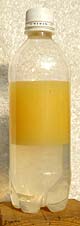
The biodiesel should separate from the water in half an hour or less, with amber (and cloudy) biodiesel on top and milky water below, and no more than a paper-thin white interface layer between the oil and water.
This is quality fuel, a completed product with minimal contaminants. Wash it and use it with confidence.
But if it turns into something that looks like mayonaisse and won't separate, or if it only separates very slowly, with a thick, creamy white layer sandwiched between the water and the biodiesel, it's not quality fuel and your process needs improvement.
If you have an emulsion layer much thicker than the normal paper-thin interface layer between the oil and the water, the batch should probably be retreated. See Reprocessing biodiesel, below.
Also try the Methanol test, see below.
See:
Washing
How the process works
How to use the quality testsWhat should you do if your fuel doesn't pass the wash-test?
The three main reasons test batches fail are failure to follow the instructions properly, inaccurate measurements, and poor-quality chemicals, in that order.
With the first one, failure to follow the instructions, comes the sad fact that there's a lot of bad information put about on how to make biodiesel. Just forget everything else you've heard, follow the instructions, step by step, don't take shortcuts, and you'll get there.
Go back to the beginning, double-check everything: Where do I start?
Frequently Asked Question: "Alright, I'm stumped. When I tried to wash the biodiesel with tap water, it formed a white emulsion. I've waited a long time but there was no separation, absolutely nothing. What happened?? What am I doing wrong??? Can I make biodiesel with this oil?"
Answer: Keep trying, make more test batches, practice makes perfect.
Learners at the Biofuel mailing list replied:
"For anyone starting out or still in the R&D phase of scaling up and tweaking the process to improve quality, disregard anything other than the tried and tested directions at Journey to Forever. Read them and then re-read them. Follow the instructions, don't add or subtract anything and you will be making quality biodiesel." -- Tom Kelly, 5 Nov 2005
Introduced at the Biofuel mailing list in 2001, the reprocessing test is a simple check that tells you if the process went far enough, with good completion of the reaction and good conversion. If not, there will still be unconverted and partly converted material in the fuel, such as diglycerides and monoglycerides, fuel contaminants that can emulsify the fuel when you wash it so that it won't separate from the wash-water.
Take a litre of finished, settled and separated fuel and process it again as if it were new oil, using 200 ml of methanol and 3.5 grams of NaOH or the equivalent of KOH. Let it settle. If any more glycerine by-product drops out, then you know the reaction wasn't as good as it should have been.
Try longer processing times, better temperature control; see more accurate measurements; make sure the titration was accurate; double-check every part of the process to make sure you're following the instructions correctly.
The reprocessing test has since been superceded by Jan Warnquist's Methanol Test (next), but it's still a useful technique to know.
Biofuel mailing list member Jan Warnqvist of Sweden developed this extremely useful test for homebrewers, first introduced at the Biofuel list in August 2005:
"The biodiesel should be fully soluble in the methanol, forming a clear bright phase. If not, there is pollution in the biodiesel. Each ml of undissolved material corresponds to 4% by volume. Is there any undissolved material at the bottom of the measuring glass? If there is, your reaction is not complete and this is causing you trouble with the water test.
"This method does not cover every aspect of quality, but it gives a hint. It is valid only for biodiesel made from vegetable and animal oils. It is not valid for biodiesel made from oils with a very wide fatty acid pattern, such as fish oils."
Jan Warnqvist
AGERATEC AB
Biofuel mailing list
Re: Quality Test, Jan Warnqvist, Thu, 11 Aug 2005
http://www.mail-archive.com/
biofuel@sustainablelists.org/msg53363.html
This means your processing didn't go far enough and needs improvement. All the oil should be fully converted to biodiesel. (See How the process works.)
If some unconverted triglycerides remain in the biodiesel, there will also be partly converted diglycerides and monoglycerides -- this is poor-quality fuel that will not meet the quality specifications and could damage your engine. Diglycerides and monoglycerides also cause emulsions when you try to wash the fuel.
A clean methanol test result with no deposit at the bottom means you've made well-completed, high-quality fuel.
The test is most accurate at room temperature, about 20-25 deg C (68-77 deg F).
Use pure 99%+ methanol with no water contamination.
After dissolving the biodiesel in the methanol, leave to settle for 30 minutes.
The test can be used with:
Determination by mass will give you a more precise result, says Jan Warnqvist:
1. One 250 ml separation funnel
2. One 400 ml beaker
3. One magnetic stirrer
4. Balance accurate to 0.05 g
5. One 50 ml E-flask with narrowed neck
Chemicals for the analysis:
1. Water-free methanol, minimum 225 g
2. FAME (Fatty Acid Methyl Esters, biodiesel) with water content less than 500 ppm, clear, bright and without visible impurities, minimum 25 g
Take the clean beaker and put exactly 225 g of methanol in it. Then add exactly 25 g of the biodiesel.
Stir the fluids with the stirrer for 2 minutes.
Take the beaker off the stirrer and pour the contents into the separation funnel.
Set the clean e-flask on the balance and set the balance to zero.
Let any oil phase separate out from the biodiesel/methanol phase and put it in the e-flask.
Weigh the contents and calculate the result as follows:
1 - m1/m2 = m3
where
m1 = the amount of undissolved material
m2 = the amount of biodiesel put into the reaction
m3 = the amount of biodiesel that is dissolved in methanol in mass %
Example:
m1 = 0.5 g undissolved material
m2 = 25 g biodiesel put into the reaction
1 - m1/m2 = m3
1 - 0.5/25 = 0.98
m3 = 98% of the biodiesel dissolved in the methanol, leaving 2% unreacted oil.
Ideally there should be no undissolved material, indicating a high conversion rate leaving no unreacted oil and only small amounts of diglyceride and monoglyceride.How to use the quality tests
For these reasons, and others, beginners should start with small (1-liter) test batches using new oil, the highest quality chemicals, and balances that allow accurate measurements.
Much of the soap settles out with the glycerine, as does most of the lye and excess methanol. Even after 12 or 24 hours of settling some of the soap, lye and excess methanol is still in the biodiesel fraction. That's why we wash it. The amount that remains is related to the amount produced in the reaction.
Using new oil eliminates not only the need to titrate, but also soap formed due to FFAs in the oil. Initial test batches with anything other than the "paper-thin" middle layer [see Wash test, above] are unacceptable because it indicates either an incomplete reaction or excess soap. Given new oil, accurate measurements, and quality chemicals excess soap should not form.
After success with small (1-liter) test batches using new oil, one may begin using WVO and eventually scale up to larger batches. This not only increases the volume of a potential disaster (see Emulsions), but also increases the number of variables that must be considered when a problem arises.
How do you know what is causing the problem?
Become familiar with the Methanol test described at Journey to Forever (see above).
If there was an incomplete reaction and various glycerides remain in the "biodiesel", they will remain undissolved in the methanol and form a residue at the bottom; reprocessing is in order (below). If the entire sample of biodiesel dissolves in the methanol, but the wash test resulted in a thicker than "paper-thin" middle layer, the problem is soap formation. If using new oil (or low-titrating WVO) and too much soap forms, consider the possibility of water contamination or inaccurate measurements/calculations.
Example: During methanol recovery (from the glycerine mix) one must consider water contamination in the distillate. Using the recovered methanol may result in a complete reaction with little soap (good methanol), complete reaction with more soap than expected (some water contamination), or incomplete reaction with a lot of soap (serious water contamination).
The more serious problems are invariably associated with the last liters of methanol that were distilled. I have had a similar experience using the last gallons of methanol from a barrel. As the barrel empties, water in the air condenses, with more water in the final gallons.
The wash test and the methanol quality tests are both valuable.
Towards the end of each reaction, I shut off the pump and draw off a sample of the mix, and then turn the pump back on. I let the mix settle for about 10 minutes and then do a solubility-in-methanol test (Methanol test) on some of the biodiesel fraction. If it passes, I pump the mix into my settling tank. If I'm making fuel for my car, and the biodiesel fails the test, I'd add a bit more methoxide and continue processing. If I'm making fuel for my oil-fired boiler (larger batches; only 16% methanol vol/vol) a small residue of unreacted oil is acceptable. Testing this way saves the expense of time and resources involved in reprocessing.
Prior to washing a batch I always do a wash test. If the batch passed the methanol test, but there is a thicker than "paper-thin" middle layer I may let it settle longer, or put a few ml. of phosphoric acid in the first wash water.
Having passed the methanol test, I wouldn't consider reprocessing.
-- TomMore quality checks
"There is a rule of thumb: the brighter yellow in color, the better the crack. As a standard you should take virgin sunflower oil yellow color in see-through sunlight. (It's a sort of colorometry). Then take a glass jar of your fuel and place it in front of a white wall in the evening. When seen in the reflected light of a tungsten bulb it should not change to orange (a very simple case of absorbtion spectrometry).
Reprocessing biodiesel
Message to the Biofuel mailing list, 22 September 2005:
Standards for biodiesel
Iodine Values
Quality standard for rapeseed oil fuel
Cetane Numbers
National standards for biodiesel
Fuel properties of fats and oils
Fuel properties of esters
US standard -- D6751-02 Standard Specification for Biodiesel Fuel (B100) Blend Stock for Distillate Fuels. Download from the ASTM site, costs $30 (pdf):
http://www.astm.org/cgi-bin/SoftCart.exe/STORE/
filtrexx40.cgi?U+mystore+mofc8213+-L+D6751+/usr6/
htdocs/astm.org/DATABASE.CART/PAGES/D6751.htm
Or: http://snipurl.com/fva4
EU standard -- DIN EN 14214, Publication date:2003-11 Automotive fuels - Fatty acid methyl esters (FAME) for diesel engines - Requirements and test methods. Order from Beuth Verlag GmbH ("search" for "EN 14214")
http://www.beuth.de/index_en.php
Standard testing:
Biodiesel fuel testing for the US ASTM D-6751 standard:
Analytical Testing Services, Inc.
http://wetestit.com/
Harris Testing Laboratories, Inc.
http://www.harristestinglab.com/quote/d6751.htmUsing biodiesel in winter
Here's what you can do about using biodiesel in cold weather:
Biodiesel in winterBiodiesel in gasoline engines
See Biodiesel in gasoline enginesTiny diesel engines
Diesel model aircraft engines range from 0.55 cc (0.033 cu in) up to 8 cc (0.48 cu in) and bigger. They fit in the palm of your hand and weigh about 250 grams (9 oz) -- great for demonstrations and student projects.
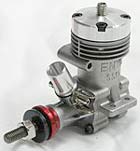
Enya's famous .15 series diesel, from Japan
These are great little engines, beautifully engineered, true compression-ignition diesels. Some of them reach 18,000 rpm.
Most models have radio control versions (remote control, R/C).
They will run on biodiesel, but not 100% biodiesel.
These little diesels are not the same as full-scale diesel engines. Instead of petroleum diesel fuel, they run on a mixture of 30% castor oil, 40% kerosene and 30% ether. You can substitute biodiesel for the castor oil and kerosene, but it still needs the ether -- 70% biodiesel and 30% ether.
As with cars, there are two types of model engines, diesels, and glow-plug engines, which are not diesels, they're more like gasoline engines, and they won't work with biodiesel. The glow-plug engines run on methanol and nitro-methane, not on oil or biodiesel. The diesel engines are more powerful, use less fuel, and they're much quieter.
Biofuel list member David Teal of the UK wrote:
"I have a good number of these engines and have been operating them for 45 years. I did some trials and mixed 70% biodiesel with 30% ether (no oil at all). Several engines ran perfectly well on this mix with no overheating or other sign of lack of lubrication.
"Model diesel engines, with a compression screw on top, are mostly made in UK (prominent makes being PAW and Irvine) and Europe (Italy, Russia, Czechoslovakia).
"The first model diesel motor was developed in the US, but diesels have never been popular there -- almost all model motors used in the US have been glow-plug motors. Davis Diesel Development offers conversion kits for many popular glow-plug motors.
"Elsewhere model diesels have been more popular. These are true diesels, compession-ignition motors, but they won't run on pure diesel fuel of any kind, whether petro-diesel of any grade, kerosene, or vegetable oil (castor oil) -- they need 30% ether. You can use biodiesel, but you still need the 30% ether.
"Chinese manufacturers make replicas of classic British diesels. These work pretty well, if not better than the originals. Seek out replica Oliver Tiger, Rivers Silver Arrow, etc. Chinese diesels. There is also an original Chinese design called Silver Swallow.
"They are 2.5 cc (0.15 cu in) and there are loads of airframe designs which will suit them.
"The Japanese produce well-regarded model aircraft engines (Enya, including diesels)."
First, decide whether you need remote control or not, if so you'll need an engine made for radio control (R/C) rather than FF (free flight) or CL (control-line). Most makes of engines have a range of R/C versions.
Then, decide what size engine you need -- check the aeromodelling sites and forums to see which kind of model planes take which engines (or helicopters, boats or cars), and make your choices.
PAW diesels: Progress Aero Works -- Manufacturers of PAW diesel engines for model aeroplanes (UK)
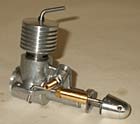
PAW's tiny 0.55 cc (0.033 cu in) single ball race engine.
http://www.eifflaender.com/
PAW diesels in the US: Doctor Diesel, full range of PAW model diesels, .03, .049, .06, .09, .15, .19, .29, .35, .40, .49, .60 cub in, complete catalog and info, $1.00 post free, e-mail doctordiesel@cafes.net
http://www.cafes.net/doctordiesel/DDengines.htm
Vintage Diesel Engines, Chinese-made replicas, from Flair Models, UK
http://www.flairmodels.co.uk/Engines/CS_Diesels/VintageDiesels.htm
Flair Models has a replica of the original US-made model diesel: Micro Diesel 2cc 1948 -- "The Micro diesel is an excellent replica of the 2 cc engine first built in 1948 in the USA. It is very easy to start and will run all day on a whiff of fuel. ... This super little engine runs like a well oiled sowing machine." http://www.flairmodels.co.uk/
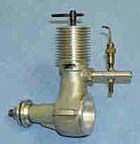
Engines/CS_Diesels/VintageDiesels.htm
Enya diesels, top-flight design and engineering from Japan: Steve Webb Models, UK
http://www.stevewebb.co.uk/index.php?
area=engines&title=Full+Range+of+Engines
Enya diesels: Model Flight, Australia
http://www.modelflight.com.au/enya-engines_diesel.htm
Sharma Model Aero Engines of India (established in 1974) makes diesel model aero engines from 1.5 to 3.2 cc R/C (0.09 to 0.2 cu in), running at up to 16,000 rpm.
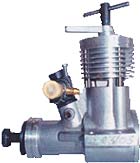
Sharma 1.5 cc R/C, 3000-16000 rpm
http://www.sharmamodelaero.com/
engine.htm
USA agents: M/s Carlson Engine Imports, 814, East Marconi Avenue, Phoenix, Arizona - 85022 phone/ fax: 602-863-1684 e-mail: carlsonengines@juno.com
UK agents: Just Engines, email: justengines@enterprise.net
http://www.justengines.co.uk
Davis Diesel Development in the US offers diesel conversion kits for many popular glow-plug engines to use model diesel fuel (or biodiesel plus ether). Conversions from 0.049 to 3.6 cu in (0.8 to 59 cc). You still have to buy the glow-plug engine.
http://www.davisdieseldevelopment.com/diesel/index.htm
Radio-control equipment, propellers and other accessories are available via many of the sites above. Many other websites supply model aircraft, from kits you build yourself to ready-to-fly models, and there are forums where beginners can learn the basics.
Biofuels
En español -- Biocombustibles, biodiesel
Biofuels Library
Biofuels supplies and suppliers
Biodiesel
Make your own biodiesel
Mike Pelly's recipe
Two-stage biodiesel process
FOOLPROOF biodiesel process
Biodiesel processors
Biodiesel in Hong Kong
Nitrogen Oxide emissions
Glycerine
Biodiesel resources on the Web
Do diesels have a future?
Vegetable oil yields and characteristics
Washing
Biodiesel and your vehicle
Food or fuel?
Straight vegetable oil as diesel fuel
Ethanol
Ethanol resources on the Web
Is ethanol energy-efficient?
