

Search the Journey to Forever website – click HERE
|
Journey to Forever: Make a donation |

Navigation
| Small farms library | |
| City farms | |
| Organic gardening | |
| Composting | |
| Small farms | |
| Introduction Sustainable farming Small farms fit References |
|
| Small farm resources | |
| Back to the land | |
| Small farms | |
| Organics | |
| Soil management | |
| Sustainable farming | |
| General resources | |
| Food storage and preservation | |
| Useful databases | |
| Community-supported farms | |
| Farming with trees | |
| Agroforestry Bamboo Resources |
|
| Farming with animals | |
| Introduction Livestock resources Cattle Sheep General Draft animals |
|
| Pasture | |
| Introduction Pasture resources Silage |
|
| Pigs for small farms | |
| Why pigs have snouts Raising pigs on soil in Japan Lady Eve's pigs Pigs on pasture Pig resources |
|
| Poultry for small farms | |
| Muscovy ducks Khaki Campbell ducks Chickens Geese Rabbits Guineafowl General tips High-protein poultry feed from thin air Poultry as unpaid labour They're not pets Doing it |
|
| Poultry resources | |
| Aquaculture for small farms | |
| Introduction Aquaculture resources |
|
| Composting for small farms | |
| Foundation On-farm composting resources |
|
| Controlling weeds and pests | |
| Weeds Weed control resources Insect pests No pesticides Insect control resources |
|
Contact usTo Keith Addison Handmade Projects |
Small farm resources
Back to the land – a 140-year trend
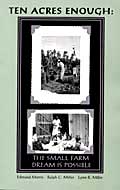 "Ten Acres Enough: The Small Farm Dream is Possible" by Lynn R Miller, Ralph C Miller, Edmund Morris, 1864, 2nd Edition 1996, Small Farmers Journal, ISBN 1885210035
First published in 1864, this is the journal of a man who moved from the city to the country a hundred years before it became the fashion. It's the story of his experiences building a small farm and living the simple life, with his advice on a range of topics such as buying land, planting peaches and berries, livestock, weeds, liquid manure, and hard financial realities. It was possible then, and it's possible now. Read it online at the Making of America (MOA) digital library:
http://moa.umdl.umich.edu/cgi/sgml/moa-idx?notisid=AJR0739
From Powell's Books:
http://www.powells.com/biblio/17-9780486437378-1
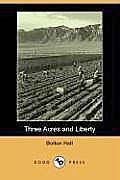 "Three Acres And Liberty" by Bolton Hall, 1907, Macmillan
This original back-to-the-land book is much more than a how-to, also a why-to, and Hall's reasons are as clearcut today as they were a hundred years ago. From the Foreword: "We are not tied to a desk or to a bench; we stay there only because we think we are tied. In Montana I had a horse, which was hobbled every night to keep him from wandering; that is, straps joined by a short chain were put around his forefeet, so that he could only hop. The hobbles were taken off in the morning, but he would still hop until he saw his mate trotting off. This book is intended to show how any one can trot off if he will." Out of print, full text online at the Soil and Health Library:
http://www.soilandhealth.org/
Buy the book from Amazon.com: Three Acres And Liberty
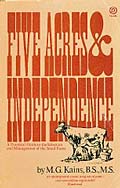 "Five acres and independence: a practical guide to the selection and management of the small farm" by Maurice Grenville Kains, 1935, 1973, Dover Publications, ISBN 0486209741
Another great back-to-the-land classic on the basics of self-sufficient farming, covers all aspects of making a small acreage profitable and livable. First published in 1935, still in demand and still in print. Costing information and some other details are out of date now, but the principles remain intact -- eg, the chapter on "Tried and True Ways to Fail". Buy at Amazon.com: Five acres and independence
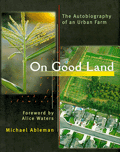 "On Good Land: The Autobiography of an Urban Farm" by Michael Ableman, 1998, Chronicle Books, ISBN 0811819213
Opens with an aerial photograph of the 12.5-acre Fairview Gardens Farm in California in 1954, part of thousands of acres of farmland, and again in 1998, surrounded by the homes and malls of a modern suburb. Ableman simply refused to let it be bulldozed -- he's in love with the place. And it's not even his: he's a tenant farmer. But it's the land itself and what it produces that matters to him. Now it's become the organically farmed Center for Urban Agriculture. Ableman's struggles and success make an inspiring story. "Michael Ableman's farm is a landmark, a source of comfort to all of us who love good farming and good food. A lot of people are grateful to him, and I am one of them." -- Wendell Berry. Buy at Amazon.com: On Good Land
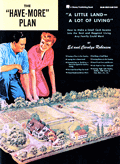 "The Have-More Plan: A Little Land -- A Lot of Living" by Ed and Carolyn Robinson, Storey Books, ISBN 0882660241
This homestead classic from the 1940s encouraged thousands to go "back to the land" to seek a better life after the Great Depression and World War II. It has been in constant demand since it was first published. A wealth of information for anyone seeking a self-reliant lifestyle. All the basic information to get started, good on property layout and building design for optimum use of space and time, useful, detailed guide. The style is dated but the message isn't! Buy at Amazon.com: The Have-More Plan
Small farms
Quality check
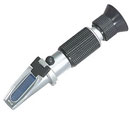 Extech RF15 Refractometer -- 0-32% Brix Sucrose Refractometer with Automatic Temperature Compensation. Measures the concentration of sugar from 0 to 32% Brix. Max resolution 0.2% Brix. Only requires 2 or 3 drops. Simple, repeatable measurements. See Brix levels for full details and quality chart. Buy at Amazon.com:
Extech RF15 Refractometer
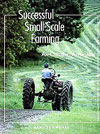 "Successful Small-Scale Farming" by Karl Schwenke, 1991, Storey Books, ISBN 0882666428
The potential and the harsh realities of living on the land. Covers organic soil management, essential machinery, market strategies, basic skills, lots of useful charts and tables. Small farms can be cleaner, smarter, and more efficient than corporate agribusiness, says Schwenke -- indeed so. Concise overview and how-to's, for one acre and up. Buy at Amazon.com: Successful Small-Scale Farming
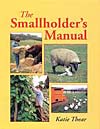 The Smallholder's Manual by Katie Thear, The Crowood Press UK, 240 pages -- Britain's "smallholder's bible". A practical handbook for anyone working on a smallholding, whether just to produce food at home, or for the sale of produce. Describes the practical requirements in terms of house, land, boundaries, buildings, tools and machinery, before moving on to the techniques of small-scale agriculture: tending the kitchen garden, orchard and pasture, growing fodder crops, greenhouses and poly-tunnels. Coverage of livestock includes: bees, chickens, waterfowl, turkeys, guinea fowl, quail, peacocks, pheasants, pigs, sheep, goats, cattle, emus and alpacas. Illustrated in colour throughout. Buy at Amazon.com: The Smallholder's Manual
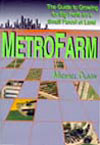 "MetroFarm: The Guide to Growing a Big Profit on a Small Parcel of Land" by Michael Olson, 1994, ISBN 0-963787-60-8
According to a recent US Census of Agriculture, the most productive farmland in the US is in the Borough of the Bronx, the second most productive farmland is in the City of San Francisco. How to earn up to eight times the average personal income on as little as one acre of land. Written for both the experienced and the novice, both modern and traditional technologies used by space-intensive farmers from around the world. Photos, charts and illustrations. From MetroFarm Online:
http://www.metrofarm.com/mf_Books.php
"Grow It! -- The Beginner's Complete In-Harmony-With-Nature Small Farm Guide -- From Vegetable and Grain Growing to Livestock Care" by Richard W. Langer and Susan McNeill (illustrator), first published in 1972, reissued 1994, Noonday, ISBN 0374523908
Practical and easy-to-use guide to small-scale organic farming, packed with good advice on "everything from building and stocking a pond to planting an orchard or making cheese". Read it or use it as a quick-reference guide. Buy at Amazon.com: Grow It! -- The Beginner's Complete In-Harmony-With-Nature Small Farm Guide
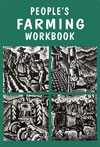 "People's Farming Workbook" Environmental and Development Agency Trust, David Philip, Cape Town, South Africa, 1995, ISBN 0 86486 112 5
For rural and resource-poor communities, the Workbook has obviously grown from the ground up, like a good crop: written by a collective, the authors know the needs of the grass-roots people the book targets. It's easy to read and easy to use, well-illustrated and well-organized to meet the needs of everyone from small farmers to backyard gardeners with little time and few resources. Simple without being simplistic, it's a mine of sheer usefulness -- an object-lesson for some of the expensive, top-heavy programs that set out to help poor rural people. Applicable anywhere in the Third World, not just South Africa. Buy from Amazon.com: People's Farming Workbook
First edition, the People's Workbook, by Robert Berold et. al., Environmental and Development Agency, Johannesburg, South Africa, download free from CD 3rd World online library, 41.7Mb pdf
http://www.fastonline.org/CD3WD_40/JF/410/02-76.pdf
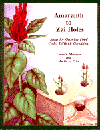 "Amaranth to Zai Holes: ideas for growing food under difficult conditions" by Laura S. Meitzner and Martin L. Price, 1996, ECHO (Educational Concerns for Hunger Organization). This book is an updated compilation of 15 years of ECHO's quarterly technical bulletin, ECHO Development Notes. "Amaranth is a drought-tolerant plant which provides both high-protein grain and delicious edible leaves. Zai holes use termites to improve soil fertility and increase water filtration in farmers' fields in West Africa. These are just two of the plants and techniques people are using to produce food under difficult growing conditions in the tropics." A treasurehouse of practical information for and from the field, mainly for people working with small farmers or urban gardeners in Third world settings -- new ideas, techniques, underutilized tropical plants, and offers of trial packets of seed to evaluate them. Full text free online:
http://www.echotech.org/technical/az/aztext/azcntnts.htm
Buy book at Amazon.com: Amaranth to Zai Holes
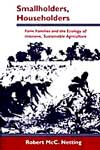 "Smallholders, Householders: Farm Families and the Ecology of Intensive, Sustainable Agriculture" by Robert McC. Netting, 1993, Stanford University Press, ISBN 0804721025
A detailed analysis of the livelihoods of farmers practising intensive, diversified and sustainable agriculture. Focuses on small farms in areas of dense population around the world. Well-researched ethnographic review of agricultural practices and their social and economic aspects, many examples showing how intensive, diversified farming systems are often efficient and sustainable alternatives to modern chemical and fossil-fuel dependent agriculture. Buy at Amazon.com: Smallholders, Householders
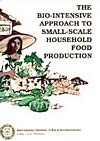 Bio-intensive Approach to Small-scale Household Food Production, International Institute of Rural Reconstruction (IIRR), Philippines, 1993, 180 pages: Vegetables throughout the year -- fight malnutrition right in your backyard! Guide to developing a home garden that can provide adequate food with minimum cost, labor and land utilization. Based on the Food Always In The Home (FAITH) organic gardening method developed and popularized in the Philippines by the Mindanao Baptist Rural Life Center (MBRLC), aimed at providing the necessary protein, vitamin and mineral requirements of a family of six. Using raised, narrow deep-dug beds, composting, continuous crop cover and mulch, crop rotation, an area of 400-500 sq ft (35-45 sq m) produces 3-6 Ibs (1-2.5 kg) per day for 300 days. Full text free online at the CD3WD Third World Library:
http://www.cd3wd.com/cd3wd_40/cd3wd/agric/ii06be/en/b144.htm
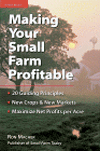 "Making Your Small Farm Profitable" by Ron Macher, 1999, Storey Books, ISBN 1580171613
Ron Macher is the editor of Small Farm Today magazine ("Our readers make money!"), the original how-to magazine for small farmers, established in 1984. This is a good overview for anyone wanting to start a small, sustainable farm and make a profit. Buy at Amazon.com: Making Your Small Farm Profitable
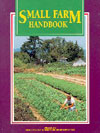 "Small Farm Handbook", Small Farm Program at UC Davis. A practical, easy-reading guide for people interested in operating a successful small farm. Tips on livestock and crop production, buying property and equipment, dealing with taxes and regulations, marketing, maintaining healthy family relationships, and more. Easy-to-use worksheets to fit your farming goals. Thirty-eight authors -- researchers, farm advisors, small farm specialists, and farmers -- covering all aspects of owning and operating a small farm: Requirements for Successful Farming, The Basics, Finances, Marketing, Selling your Product, Enterprise Ideas, Growing Crops, Raising Animals, Postharvest, Alternative Agriculture, Labor Management, Keeping the Family Farm Healthy, Worksheets, resources and references. Buy at Amazon.com: Small Farm Handbook
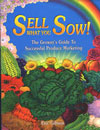 "Sell What You Sow! The Grower's Guide To Successful Produce Marketing", by Eric Gibson, 1993, New World Publishing, ISBN 0963281402
This how-to book reveals the tricks of the trade from master marketers around the US. High-value produce marketing for farmers and market gardeners, hands-on information, practical, how-to guidance on selling what you grow and making profits from produce. "Far-and-away the outstanding farm produce marketing text. If you're trying to sell what you grow, this book will quickly pay for itself." Buy at Amazon.com: Sell What You Sow!
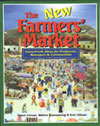 "The New Farmers' Market" by Vance Corum, Marcie Rosenzweig & Eric Gibson, 2001, New World Publishing; ISBN: 0963281429
If you want to succeed at farmers' markets in the US, this is the book for you. A "must have" for farmers' market sellers, managers, market planners, and farmers' market community. "Finally, a really good book on farmers' markets!" Buy at Amazon.com: The New Farmers' Market
"Countryside & Small Stock Journal -- The Magazine of Modern Homesteading" -- promoting self-reliance and simple life style through home food production, gardening, cooking, food preservation and other homesteading techniques. "91 years old, and a new wrinkle with every issue!" Gardening, small-scale livestock, cooking, food preservation, resource conservation, recycling, frugality, money management, alternative energy, old-time skills, home business, and more. Useful how-to's and practical information, detailed and well-written -- stuff you need to know. Features from back issues online, back issues available (unless sold out), contents listed. Good bookstore, lots of useful guides and resources for the homesteader.
http://www.countrysidemag.com/
"Tools for Agriculture: A guide to appropriate equipment for smallholder farmers" by Ian Carruthers and Marc Rodriguez, 4th edition 1992, 270 pages, Practical Action, ISBN 185339100X
Unique guide to small-scale farming equipment. Each subject is introduced by an expert who sets the available tools against the background of good farming practise. Helps you evaluate what's most suitable for your situation. Analyses why some projects are successful and suggests ways to improve them. Land preparation, sowing and fertilizing, pest control, harvesting, water lifting, livestock care, beekeeping. With lists of manufacturers (mostly in the Third World). Download the complete book free from the CD3WD online 3rd World library (24.9Mb pdf):
http://www.fastonline.org/CD3WD_40/JF/417/06-256.pdf
Buy the book from the Development Bookshop: Tools for Agriculture
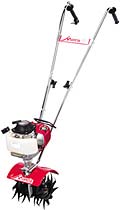 The Mantis lightweight tiller is not just a junior-sized toy cultivator, it's an effective tool that can do things a full-sized cultivator can't do, apart from working in much smaller spaces.
The Mantis weighs 20 pounds (9 kg). It was designed 30 years ago for professional landscape gardeners and it's the world's best-selling tiller, with more than a million sales.
The twisted "serpentine" tines spin at 240 RPM -- twice the speed of ordinary tillers, digging down to 10" (25cm), cutting through hard sod, compact soil or tough weeds, turning it all into finely textured soil ready for planting. The 9-inch (23cm) tilling width makes tilling or cultivating between rows easy.
The Mantis breaks sod and chops it up, incorporates organic matter, mixes in compost or lime, works soil in tight spaces, including raised beds, weeds between rows and among plants.
Switch the tines around and dig just a couple of inches into the soil to weed a large 30 x 40 ft garden (9 x 12 metres) in 20 minutes, chopping in the weeds as you go.
Available in three models: with an electric motor, a 2-cycle gasoline engine, or a Honda 4-cycle gasoline engine -- the Honda engine model is more powerful and quieter, it weighs 4 pounds more at 24 pounds (10.8 kg) and it's more expensive.
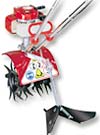 The attachments fit all three models: the Planter/Furrower has two special tines that dig deep, 6"-wide furrows in any soil -- for tomatos, corn, beans, potatoes, asparagus, onions, root crops, also for building raised beds and cutting trenches; the Plow attachment is propelled forward by the spinning tiller tines, you walk behind -- the hardened steel plow blade forms straight furrows, deep or shallow, much faster than working by hand, banks soil for planting; also Border Edger, Lawn Dethatcher, Lawn Aerator, Hedge Trimmer Bars, more.
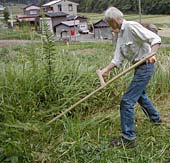 Clearing rough grass and weeds at our farm in Tamba, Japan -- we have two traditional European scythes from Slovenia, where local people still use scythes. 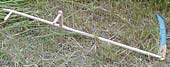 |
"In this age when most wonder how you can accomplish anything without the aid of electricity or gasoline, we must reassert that a hand tool finely made has greater versatility, has comparable efficiency even in large areas, and even makes for good exercise because the tool fits the dynamics of the body. Most importantly, a finely made tool does not interfere with personal communion with the ever-amazing natural world." A well-researched manual on the (almost) lost art of using a scythe: how to use a scythe with little effort. Tresemer delves into subjects such as the Alexander Technique, relaxation and mind-body techniques to explain the relaxed, natural swing that cuts the best -- Zen and the art of the scythe (though he doesn't say so). Interesting recounting of the history of the scythe (it took about 2,000 years to develop it). Includes sections on scythe maintenance and harvesting and processing small grains. A real pleasure to read. Download the complete book free from the CD3WD online 3rd World library (7.1Mb pdf):
http://www.fastonline.org/CD3WD_40/JF/417/06-273.pdf
Buy the book at Amazon.com: The Scythe Book
Scythe Supply offers high-quality European-style scythes, scythe blades, snaths, whetstones, hammers, anvils and equipment. "We are scythe enthusiasts and want others to discover this wonderful tool." Lots of content and a workshop section with how-to explanations and photos.
http://www.scythesupply.com/
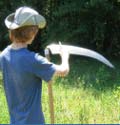 Marugg scythes -- "To our knowledge we our the only company in the U.S. still making curved hickory snaths for European style scythes." Marugg Blades are custom made by a company in Austria that has been making blades since 1540. "We are happy to report that a scythe renaissance is underway, as sustainable agricultural methods are adopted by farmers in the developed world and the internet brings availability of these awesome tools to the emerging nations. We ship worldwide. — Allen and Amy Wilson"
http://www.themaruggcompany.com/index.html
The Scythe Network, a co-operative group committed to promoting the use of the scythe. Technical and instructional arcticles online. Sells European blades, snaths, accessories online.
http://www.scytheconnection.com/
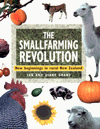 "The Smallfarming Revolution -- New beginnings in rural New Zealand" by Ian and Dianne Grant, 1998, Penguin. Part 1 -- The smallfarming way of life; 25 Secrets of Successful Smallfarmers; Promising Smallfarming Ventures. Part 2 -- 21 case studies of different types of small farms and small farm enterprises throughout New Zealand. For new and budding small farmers and existing farmers looking for new ideas. From Smallfarmers Association of New Zealand:
http://www.taranakigate.co.nz/shop.htm
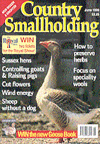 Country Smallholding -- Britain's Smallholding Site. "Country Smallholding" magazine was started as a bi-monthly in 1975 by David and Katie Thear at a time when there was no publication available for smallholders and the whole climate was one of intensive, chemical farming. They learnt to cultivate the soil organically and to raise animals and poultry humanely -- efforts supported by John Seymour, the self-sufficiency author, Lawrence D. Hills, founder of the Henry Doubleday Association, Britain's organic gardening society, and Dr Fritz Schumacher, author of "Small is Beautiful: Economics as if People Mattered". Initially called Practical Self Sufficiency, then Home Farm, now Country Smallholding, published monthly. Subscribe online, site has good resources for smallholders: wide selection of books for smallholders and poultry keepers, links to British resources. Online articles on alpacas, growing / horticulture, alternative technology, machinery, bees, smallholdings, cattle, pigs, climate, poultry, cookery, diy, sheep, equine, trees, vet's forum, wildlife, goats, and more.
http://www.countrysmallholding.com/
Katie Thear's Broad Leys Publishing is a small independent British publisher that specialises in books for smallholders, homesteaders, poultry keepers and organic gardeners. Katie Thear has been writing and publishing in this field for over 30 years, and was co-founder of Britain's "Country Smallholding" magazine in 1975. Good booklist, selection of online articles on poultry keeping and smallholding, links to resources.
http://www.blpbooks.co.uk/
Backwoods Home Magazine sets out to help you achieve a more self-sufficient lifestyle for yourself and your family. Solid, practical, hands-on information on a wide range of self-reliance topics, written by people who are out there doing it. Country living, building a homestead, tools, gardening, livestock, alternative energy, making a living, self-sufficiency, preparedness, homeschooling, crafts, nature, how-to's, achieving independence, and more. This magazine is a great resource. Six anthologies available (special offers), back issues, selected articles online, and a good bookstore.
http://www.backwoodshome.com/
Homestead.org Online Homesteading and Small Farming Resource -- site for back-to-the-landers. What is homesteading/What is a homesteader? -- Aren't homesteaders just [survivalists/hippies/eco-nuts/etc.]? -- How does one begin homesteading? -- Where can I get more information? Right here is a good place to start. How-to's and other articles, bookstore -- old copies of Mother Earth News and more, Homesteading FAQ, large collections of resources on agriculture, animals, everything else to do with sustainable farming, and a Kids' Korner. Most resources conveniently grouped into Internet Sites, Literature, Organizations, Suppliers, Usenet Newsgroups.
http://www.homestead.org/
 Lehman's Country Life blog -- "The new and improved online simplicity village", user-powered community blog run by Lehman's Non-electric -- "Serving the Amish and others without electricity with products for simple, self-sufficient living since 1955."
http://countrylife.lehmans.com/
HOMESTEAD Discussion Group -- Internet community of several hundred homesteaders.
Subscribe: email listserv@unc.edu, leave subject blank, in the body of the email, type:
subscribe Homestead
Or subscribe online:
http://help.unc.edu/?id=62#d0e86
See also Appropriate technology agriculture resources
Small farm resources
Back to the land -- a 140-year trend
Small farms
Organics, Sustainable farming
General
Food storage and preservation
Useful databases
Small farms
Small farm resources
Community-supported farms
Farming with trees
Farming with animals
Pasture
Pigs for small farms
Poultry for small farms
Aquaculture for small farms
Composting for small farms
Controlling weeds and pests
Small farms library
City farms
Organic gardening
Building a square foot garden
Plant spacing guides
No ground? Use containers
When to sow what
Seeds
Garden pond
Gardening resources
Composting
Making compost
Composting resources
Composting indoors
Vermicomposting
Humanure
Composting for small farms
